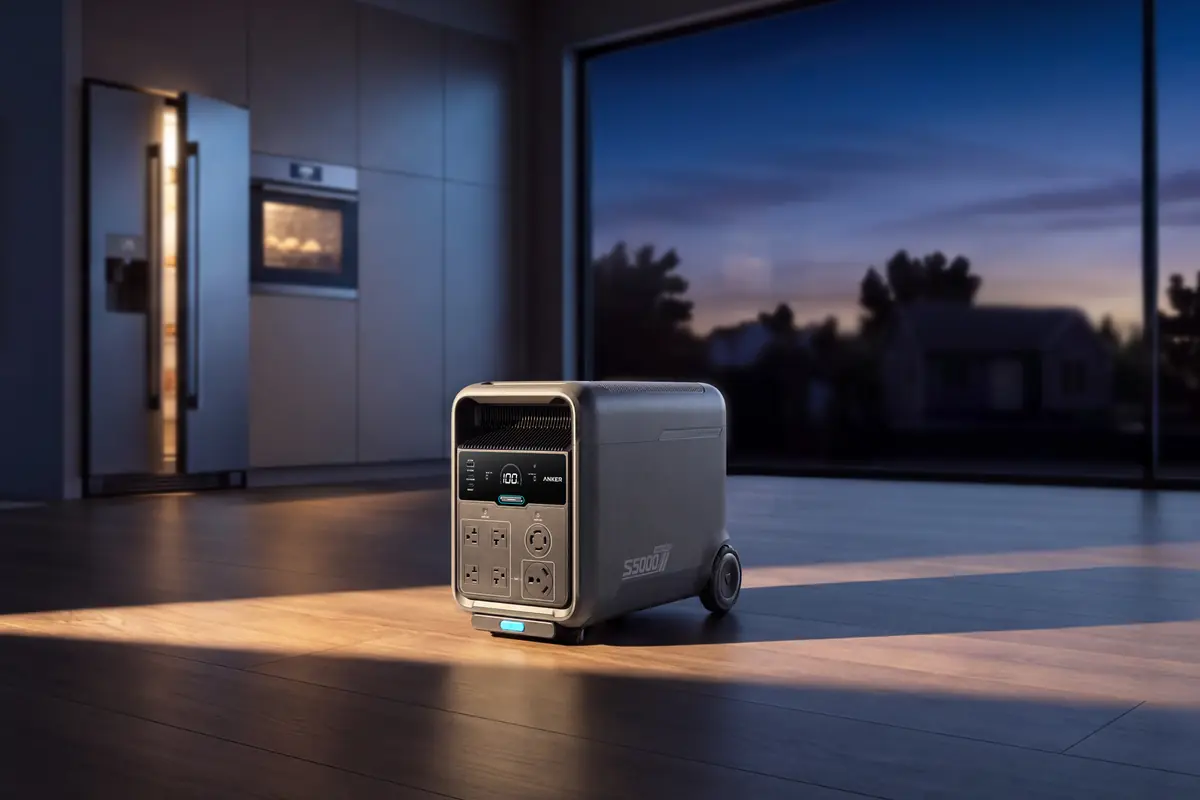
Anker SOLIX is a young energy brand attached to an older charging company. Anker Innovations began in 2011 as a small electronics and charging business; it formally gathered its solar, portable-power and home-energy products under the SOLIX name in 2023.
That distinction matters. Anker had sold portable power products before SOLIX existed, but the brand structure, product names and home-energy strategy are newer. A 2015 product is part of the lineage without having been sold under the SOLIX brand at the time.
Origin: a charging company moved into energy
Anker Innovations was founded in December 2011 by Steven Yang, a former Google algorithm engineer. The company says it is headquartered in Changsha, China, with more than 30 or 50 offices worldwide depending on the page, and is now listed in Shenzhen and Hong Kong. [1][2]
Its original reputation came from chargers, cables and battery accessories. That experience in power conversion and consumer electronics explains why Anker SOLIX emphasizes compact size, fast charging, app control and a polished device interface instead of only raw capacity.
The parent company is Anker Innovations. SOLIX is not a separate public company. Its US store operates within the Anker group and sells portable stations, solar panels and home-energy products. [1][2][3]
The brand launch
Anker announced SOLIX at a New York event in June 2023. The launch moved the existing PowerHouse portable stations into the SOLIX family and added balcony solar, modular home storage and related energy products. [3][4]
Anker SOLIX's own "about" timeline reaches back further, describing earlier portable stations, solar generators and LFP products as part of its history. Those products were part of Anker's energy business before the brand launch, so the timeline is best read as a product lineage rather than evidence that the SOLIX name existed from 2015 onward. [4][5]
The parent has continued to reinforce the consumer-tech positioning. Its product pages emphasize app controls, compact industrial design, high-wattage USB-C and fast AC charging. Those are meaningful benefits in a category where interfaces and port selection are often weak. [6][7]
How Anker SOLIX positions its range
The current range covers three broad jobs:
| Job | Verified example | Published starting point | US price snapshot |
|---|---|---|---|
| Portable 1kWh | Anker SOLIX C1000 Gen 2 | 1,024Wh; 2,000W rated, 3,000W peak; 600W solar; 24.9 lb [6] | $599.99, checked 2026-11-03 [6] |
| Expandable 2kWh | Anker SOLIX F2000 | 2,048Wh; 2,400W; 1,000W solar; expansion to 4,096Wh with one battery [7] | Price not captured in this profile |
| Larger home-oriented system | Anker SOLIX F3000 | 3,072Wh; 3,600W; 2,400W solar; expansion to 24kWh [8] | $1,899.99, checked 2026-11-03 [9] |
C1000 Gen 2 prioritizes compact carrying and fast recharge. It does not support battery expansion. F2000 keeps a similar portable form while adding an expansion battery. F3000 adds wheels, much more weight and a home-oriented configuration. The model suffix and generation are more important than the word SOLIX. [6][7][8]
Credibility: design, charging and measured output
Anker's strongest evidence is in product-level tests, not a single brand-wide ranking. MacRumors found C1000 Gen 2 capable of running a full Mac setup for nearly a day with substantial rest time and described the unit as versatile and well made. It also found it loud under high load and charging. [10]
Android Authority called it a strong travel and camping station, praising portability and five AC outlets while noting the absence of an ambient light. [11]
CHIP's German laboratory measured 839Wh through the AC outlet from the nominal 1,024Wh battery and found a one-hour average AC charge. It rated performance and feature depth well but criticized fast-charge noise. [12]
The Technology Man measured 907Wh from a 1,000W resistive load and a 47-minute full AC charge, slightly faster than Anker's 49-minute claim. It also observed an overheating shutdown when a 2kW heater ran close to the unit. [13]
Those results support the fast-charging and efficiency story while showing why "compact" and "powerful" should not be confused with "suitable for every continuous high load."
What Anker SOLIX does not do well
The clearest model-specific limitation is C1000 Gen 2's lack of battery expansion. Anker removed expansion to make the unit smaller and lighter than the previous C1000. A buyer who later needs 2kWh must add another station or replace the model. [6]
Fast charging can be loud. MacRumors and CHIP both reported noticeable noise during high-rate charging, even when ordinary output was relatively quiet. That matters in a bedroom, small van or apartment where the station charges overnight. [10][12]
High-output limits remain. The product can run many appliances, but one independent test experienced a thermal shutdown with a 2kW heater placed close to the unit. The manual's ventilation instructions and the appliance's continuous demand still apply. [13]
Our take: where Anker SOLIX is strongest
Our take: Anker SOLIX is strongest when a buyer wants a polished, compact 1kWh station with fast charging and strong USB-C output. C1000 Gen 2 is a credible alternative to EcoFlow DELTA 3 Plus and Jackery Explorer 1000 v2 when expansion is not required.
Our take: Buyers who care most about future battery growth should move to F2000 or a different modular platform instead of assuming the SOLIX name guarantees expansion.
Who should trust Anker SOLIX
Anker SOLIX fits travelers, remote workers, campers and apartment users who value a compact device, many outlets and fast turnaround between charges. It is also a reasonable short-outage bridge for routers, laptops, lights and selected appliances.
Trust the brand after checking the exact generation, expandability, outlet count, noise expectations and thermal limits. A familiar charger brand is useful evidence of power-electronics experience, not a promise that every energy product behaves the same way.
Official site
Visit Anker SOLIX
Check current US models, regional configurations, bundles and warranty terms.
Some links to manufacturer stores are commercial. We may earn a commission at no extra cost to you. Read the disclosure.
Evidence note
This brand story uses Anker Innovations and Anker SOLIX publications plus independent product reviews. Brand launch dates and pre-existing product history are kept distinct.
Source list
- [1]About Anker InnovationsAnker · accessed 2026-11-03
- [2]Anker Innovations corporate storyAnker Innovations · accessed 2026-11-03
- [3]Anker SOLIX partner overviewAnker SOLIX US · accessed 2026-11-03
- [4]Anker expands into home energy solutions with launch of Anker SOLIXAnker Innovations / PR Newswire · accessed 2026-11-03
- [5]Anker SOLIX about and product timelineAnker SOLIX US · accessed 2026-11-03
- [6]Anker SOLIX C1000 Gen 2 product pageAnker SOLIX US · accessed 2026-11-03
- [7]Anker SOLIX F2000 product pageAnker SOLIX US · accessed 2026-11-03
- [8]Anker SOLIX F3000 product pageAnker SOLIX US · accessed 2026-11-03
- [9]Anker SOLIX F3000 collection and pricesAnker SOLIX US · accessed 2026-11-03
- [10]Review: Anker SOLIX C1000 Gen 2MacRumors · accessed 2026-11-03
- [11]Anker SOLIX C1000 Gen 2 reviewAndroid Authority · accessed 2026-11-03
- [12]Anker Solix C1000 Gen 2 im TestCHIP · accessed 2026-11-03
- [13]Record-breaking charge speed? Anker SOLIX C1000 Gen 2 reviewThe Technology Man · accessed 2026-11-03