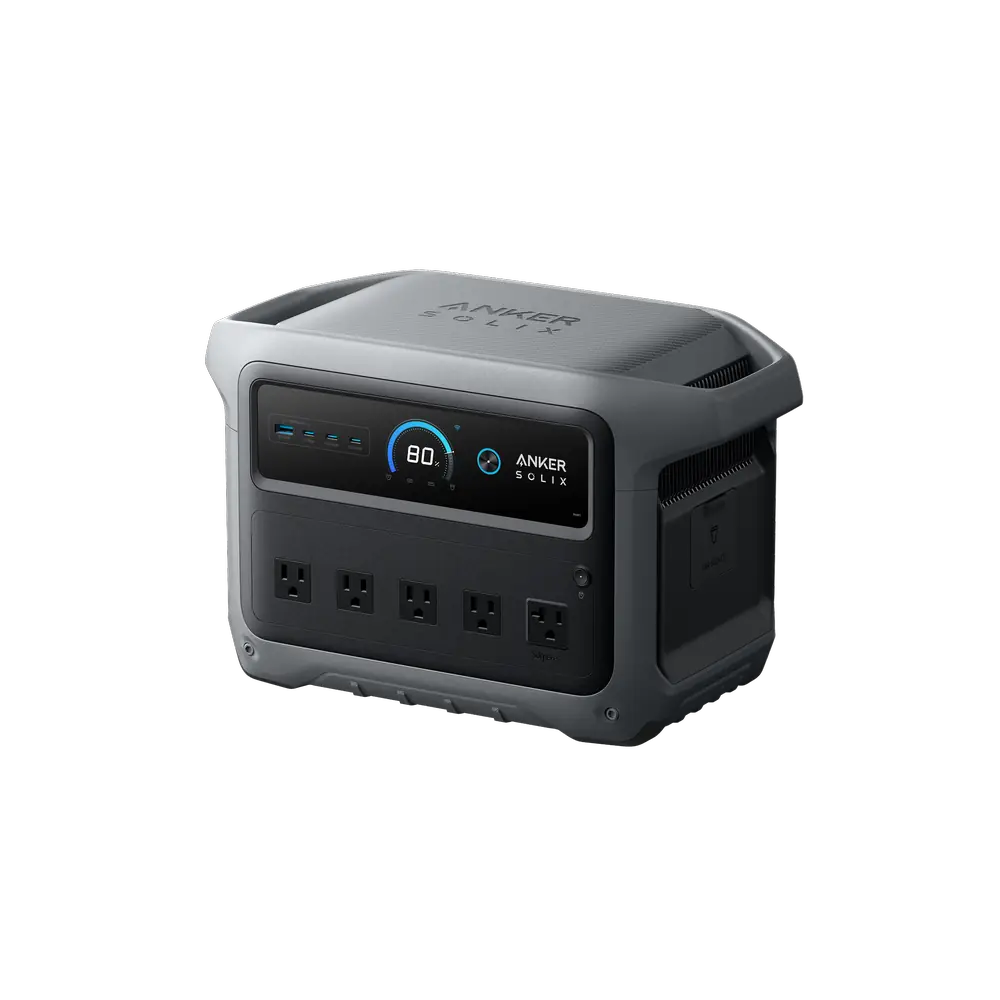
The Anker SOLIX C1000 Gen 2 is a compact 1,024Wh power station with a 2,000W AC inverter and some of the fastest charging in its class. It targets travelers, remote workers and home users who need a short-term power buffer.
Anker made a deliberate trade-off: the Gen 2 is smaller and lighter than the previous C1000 but no longer supports an expansion battery. That decision defines who should buy it.
Product identity and evidence standard
This desk review covers the US C1000 Gen 2, model A1763. It is not the original C1000 and not the larger F2000. Specifications come from Anker SOLIX's US product page. Performance findings come from MacRumors, Android Authority, CHIP and The Technology Man. [1][2][3][4][5]
We did not test a unit. Independent tests from different regions can use different outlet voltages, so exact charge and efficiency results should be read with their local context.
Anker SOLIX C1000 Gen 2 specifications
| Specification | Published detail | Source |
|---|---|---|
| Capacity | 1,024Wh | [1] |
| Battery | LiFePO4 | [1] |
| Rated AC output | 2,000W; 3,000W peak | [1] |
| AC outlets | 5 | [1] |
| USB outputs | 2 × 140W USB-C, 1 × 15W USB-C, 1 × 12W USB-A | [3] |
| Car output | 120W | [3] |
| AC input | 1,600W maximum UltraFast mode; 1,200W standard | [1] |
| Solar input | 600W maximum, 60V ceiling | [1] |
| Weight | 24.9 lb / about 11.3kg | [1] |
| Cycle rating | 4,000 cycles to at least 80% capacity | [1] |
| UPS | 10ms | [1] |
| Expansion | Not supported on Gen 2 | [1] |
| Price snapshot | $599.99, checked 2026-11-03 | [1] |
UltraFast charging must be activated in the Anker app and depends on battery temperature. The fastest time does not apply automatically out of the box. [1]
Measured capacity and efficiency
The Technology Man ran a 1,000W resistive heater and measured 907Wh delivered from the rated 1,024Wh battery. It found a 47-minute full recharge, faster than Anker's 49-minute public claim. [5]
CHIP's European test measured 839Wh through the AC outlet, 857Wh through USB-C and a full-cycle efficiency of about 72% when the energy required at the wall was included. That is a different calculation from the AC-output-only number and explains some of the spread between reviews. [4]
The practical planning number should therefore be conservative. Do not assume every watt-hour printed on the box reaches an AC appliance. Inverter conversion and charging losses consume part of the battery energy.
Fast charging and noise
Anker says the unit can charge from 0–100% in 49 minutes with 1,600W input. The Technology Man measured 47 minutes, while 9to5Toys consistently approached the 49-minute figure after enabling the fast mode. Both results support the claim. [1][5][6]
CHIP measured about one hour and one minute in its European test and found fast charging clearly audible. MacRumors also reported that the C1000 Gen 2 can be loud while charging or powering high-draw appliances. [2][4]
That does not make the unit unsuitable for a home or van. It means fast charging is a purposeful mode with acoustic cost. A buyer who sleeps beside the station may prefer standard charging, even if it takes longer.
Real-world use
MacRumors ran a full Mac setup that included a MacBook Pro, Studio Display, three LED lights and a phone charger. The setup lasted almost 24 hours, including several hours in rest mode. The unit also powered corded tools and lights around the house. [2]
Android Authority used the C1000 Gen 2 for remote work and camping and called it powerful enough for the reviewer's devices while remaining easy to carry. It highlighted five AC outlets and the number of USB ports, while noting that there is no ambient light. [3]
CleanTechnica used it for a four-day overlanding trip as a power buffer for a refrigerator and charging gear. The station performed without reported issues. That is a useful vehicle scenario, not evidence that it can replace a dedicated house battery or dual-battery installation. [7]
The Technology Man's 2kW heater test ended with a thermal shutdown after 26 minutes, and the heater was close to the unit. This is a reminder to follow ventilation guidance and to avoid treating a 2,000W rating as permission for continuous abuse. [5]
Solar and recharge flexibility
The C1000 Gen 2 accepts up to 600W of solar, more than the 400W limit on the Jackery Explorer 1000 v2 but less than the 1,000W total on the EcoFlow DELTA 3 Plus. [1][8][9]
The voltage window affects which panels are practical. The Technology Man found that reaching the full 600W required higher-voltage panels, while compact low-voltage panels were limited to a much lower input. The number on the box is therefore not a promise for every folding panel. [5]
Solar also competes with carrying space. A panel array large enough to produce 600W can be bulky and expensive, which undermines the compact-station advantage. Match the panel plan to the trip rather than buying the station first and assuming the sun will fill it quickly.
Ports, weight and handling
At around 24.9 lb, C1000 Gen 2 is light enough for one person to carry short distances but still heavy enough to require a deliberate lifting plan. Its compact form fits closets and vehicle storage better than many 1kWh competitors. [1][2][3]
Five AC outlets are a genuine advantage for a small work setup. The two 140W USB-C ports can run high-power laptops without using the inverter. The USB-A port is only 12W, so older devices charge slowly compared with the newer USB-C ports. [1][3]
There is no integrated ambient light and no expansion port. Those are clear differences from the original C1000 and from expandable competitors. [1][3]
Pros and cons
Pros
- 2,000W rated AC output and 3,000W peak are strong for a compact 1kWh station. [1]
- Fast AC charging is supported by multiple independent tests. [4][5][6]
- Five AC outlets and two 140W USB-C ports cover a practical work setup. [1][3]
- At 24.9 lb, it is easier to carry than EcoFlow DELTA 3 Plus. [1][8]
- The 4,000-cycle LFP rating and 10ms UPS are competitive. [1]
Cons
- Gen 2 cannot accept an expansion battery. [1]
- UltraFast charging is loud in independent tests. [2][4]
- There is no ambient light. [3]
- High-output continuous use still needs ventilation and load discipline. [5]
- The 600W solar ceiling is behind the 1,000W EcoFlow input. [1][8]
Compared with 1kWh competitors
| Attribute | Anker SOLIX C1000 Gen 2 | EcoFlow DELTA 3 Plus | Jackery Explorer 1000 v2 |
|---|---|---|---|
| Capacity | 1,024Wh [1] | 1,024Wh [8] | 1,070Wh [9] |
| Rated AC output | 2,000W [1] | 1,800W [8] | 1,500W [9] |
| Maximum solar | 600W [1] | 1,000W [8] | 400W [9] |
| Weight | 24.9 lb [1] | 27.6 lb [8] | 23.8 lb [9] |
| Expansion | No [1] | Yes [8] | No [9] |
| Fast AC recharge | 49 minutes claimed [1] | 56 minutes claimed [8] | About 1 hour emergency mode [9] |
| US price snapshot | $599.99 [1] | $719 sale / $799 regular [8] | $589 [9] |
The Anker is the compact-output winner. DELTA 3 Plus has the strongest expansion and solar story. Explorer 1000 v2 is the lightest and cheapest in these snapshots, but it has lower AC output and solar input. [1][8][9]
This is a genuine three-way trade-off, not a ranking that works for every user.
Score and scoring method
Desk-review score: 8.4/10
The score is an editorial fit assessment, not a Power Storage Guide lab result.
| Criterion | Weight | Assessment |
|---|---|---|
| Capacity and output | 25% | Excellent output for 1kWh. |
| Charging | 20% | Fast AC and useful solar, with noise trade-off. |
| Measured efficiency | 20% | Strong output results, but test methods vary. |
| Ports and portability | 20% | Compact with five AC outlets. |
| Expansion and software | 15% | Good app, but no battery expansion. |
Our take
Our take: C1000 Gen 2 is the best match for a buyer who wants a compact 1kWh station with strong AC output and fast turnaround. It is a practical remote-work or camper-van battery if noise during fast charging is acceptable.
Our take: The lack of expansion is more important than the price difference for a buyer planning a larger system. In that case, DELTA 3 Plus or a larger Anker F2000 is a more coherent starting point.
Verdict
The Anker SOLIX C1000 Gen 2 is a strong compact power station. Its output, port selection, measured efficiency and fast charging outweigh its lack of expansion for many users.
Buy it for travel, remote work and short outage support where size and output matter more than battery growth. Skip it if expansion, the highest solar input or the quietest possible fast charging are essential.
Next step
Use the explainer in a buying decision
Evidence note
This is a desk review, not a first-hand test. Specifications come from Anker SOLIX's US product page; measured performance is attributed to named independent publications. Price was checked November 3, 2026.
Source list
- [1]Anker SOLIX C1000 Gen 2 product pageAnker SOLIX US · accessed 2026-11-03
- [2]Review: Anker SOLIX C1000 Gen 2MacRumors · accessed 2026-11-03
- [3]Anker SOLIX C1000 Gen 2 reviewAndroid Authority · accessed 2026-11-03
- [4]Anker Solix C1000 Gen 2 im TestCHIP · accessed 2026-11-03
- [5]Record-breaking charge speed? Anker SOLIX C1000 Gen 2 reviewThe Technology Man · accessed 2026-11-03
- [6]Anker SOLIX C1000 Gen 2 portable power station tested review9to5Toys · accessed 2026-11-03
- [7]The Anker SOLIX C1000 Gen 2 portable power station testedCleanTechnica · accessed 2026-11-03
- [8]EcoFlow DELTA 3 Plus user manualEcoFlow · accessed 2026-11-03
- [9]Explorer 1000 v2 basic informationJackery Support · accessed 2026-11-03
- [10]BLUETTI Elite 100 V2 collectionBLUETTI US · accessed 2026-11-03