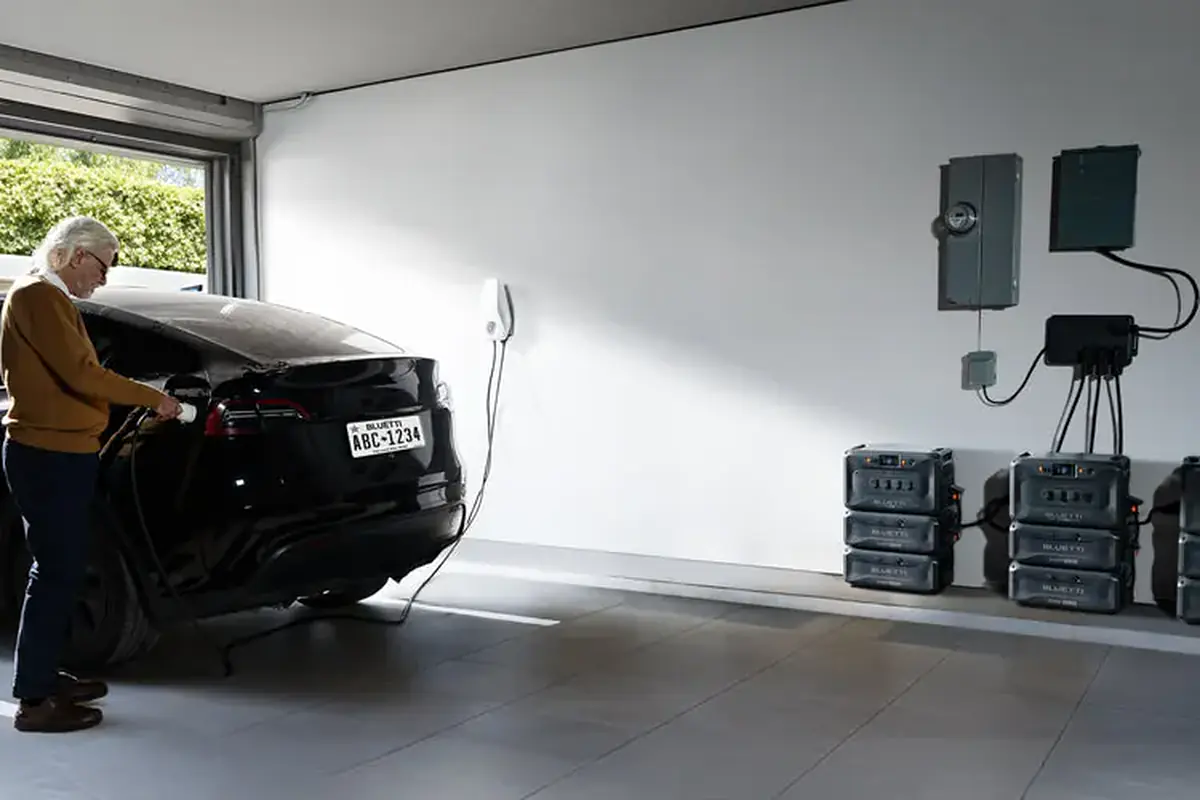
BLUETTI built its consumer reputation on large portable batteries and crowdfunding. The brand now spans compact camping stations, 2kWh-class portable units, modular home backup and solar accessories.
Its history is less linear than a single timeline suggests. Official pages disagree on whether the BLUETTI brand launched in 2019 or 2020, so this profile keeps the conflict visible. The underlying company is older than the consumer brand.
Origin: from PowerOak to a consumer brand
BLUETTI's corporate material traces the business to Shenzhen Poweroak Newener Co., Ltd., established in 2013. The company says its engineering work began earlier, but 2013 is the documented corporate starting point used here. [1][2][3]
The consumer-brand story centers on founders Wondar Law and James Ray. BLUETTI says they met in California in 2019 and launched the first EB150 and EB240 products that year, followed by the AC200 crowdfunding campaign in 2020. A separate corporate milestone page labels 2020 as the inaugural BLUETTI brand year. [1][2][4]
Both dates can be true in different senses: product sales may have begun in 2019 while the global independent-brand strategy was formalized in 2020. The reviewed sources do not resolve that distinction explicitly, so readers should not present one date as the only history.
The US operating presence is clearer. BLUETTI describes a North American headquarters in Las Vegas, while the Chinese parent uses Shenzhen Poweroak Newener as its operating entity. Manufacturing and R&D locations listed by the company include sites in Huizhou and Chuzhou, China, plus an Indonesia production base. [2][3]
Crowdfunding created the launch platform
The AC200 was the breakthrough. BLUETTI says the Indiegogo campaign raised nearly $7 million, with later products using the same direct-to-consumer launch model. The AC300, AC500 and Apex 300 then moved the catalog toward higher output, modular batteries and 120V/240V home configurations. [1][2][5]
That launch style explains part of the brand's product language. Crowdfunding rewards early adopters with unusually detailed configuration tiers, early pricing and accessory bundles. It also creates a long list of similarly named products whose differences are easy to miss after the campaign ends.
Modern buyers therefore need to compare the exact model, generation, battery family and regional voltage. A brand-level statement about BLUETTI expansion or output may apply to one modular system but not to a fixed-capacity portable unit.
A product ladder that crosses categories
Three verified current examples show the range:
| Job | Model | Published starting point | US price snapshot |
|---|---|---|---|
| Portable 1kWh power | BLUETTI Elite 100 V2 | 1,024Wh and 1,800W | $499, checked 2026-11-03 [6] |
| Larger fixed-capacity station | BLUETTI Elite 200 V2 | 2,073.6Wh, 2,600W, 53.4 lb | $899, checked 2026-11-03 [7] |
| Expandable or home-oriented systems | Apex 300 / AC series | Configuration-specific; confirm battery compatibility, output and transfer hardware | Price varies by configuration; a current standalone snapshot was not captured |
The gap between Elite 200 V2 and the modular systems is not merely capacity. The larger systems introduce expansion batteries, different inverter architectures and installation questions. A portable Elite unit remains a movable appliance; a home-oriented system may need an electrician, transfer equipment or a dedicated battery plan. [2][7]
Credibility: design awards and measured performance
BLUETTI lists Red Dot, iF and CES recognition across its product history. Those are company-published records and are useful as evidence of design recognition, not as proof that every model performs equally well. [1][2]
Independent testing is more useful for current purchase decisions. TechRadar gave the Elite 200 V2 a four-star review, praising its 2,073.6Wh battery, 2,600W output, four AC outlets and UPS use while criticizing its 53.4 lb weight, lack of wheels and lack of weather protection. [8]
StorageReview measured 1.91kWh delivered from Elite 200 V2 and 2.44kWh required for a recharge. It also ran the unit as a UPS for a small server rack through repeated grid disconnects without reboots or instability. [9]
The Solar Lab measured 94% efficiency, lower idle draw than expected and a sustained overload beyond the rated inverter output. It still criticized the app as dated and the branded solar panels as expensive. [10]
CNN Underscored named Elite 200 V2 its best solar generator after testing high-draw loads and outdoor solar charging. A category win from one publication is useful, but it does not erase the unit's weight and weather limits. [11]
What BLUETTI does not do well
The strongest repeated criticism is physical handling. Elite 200 V2 weighs about 53.4 lb, has no wheels and is not weatherproof. It can be moved, but it is not a grab-and-go unit for long carries or wet campsites. [7][8]
The app and ecosystem are less polished than the hardware in some reviews. The Solar Lab described the app as dated and noted that branded solar panels can be expensive. TechRadar found some features accessible only through the app. [8][10]
Product naming and compatibility are another ownership risk. Elite, AC, Apex and B-series batteries do not form one universal compatibility set. Buyers must confirm the exact battery family and cable, especially when considering used or older stock. [2][7]
Finally, BLUETTI marketing uses several "world's first" and "99%" statements. Those claims may originate in company testing or product launches, but the reviewed pages did not provide enough independent methodology to repeat them as neutral facts. [1][7]
Our take: where BLUETTI is strongest
Our take: BLUETTI is strongest when capacity, output and value matter more than carrying comfort. Elite 200 V2 is compelling for a van, workshop or short home outage where the unit can live near the load and be moved only occasionally.
Our take: A buyer who needs a light camping station or polished energy-management software should compare EcoFlow, Jackery and Anker SOLIX before choosing on capacity alone.
Who should trust BLUETTI
BLUETTI deserves consideration from buyers who need substantial portable output, multiple AC outlets and a known path into larger battery systems. It is also relevant where a 2kWh unit will serve as a compact UPS or job-site reserve.
Trust the brand after checking the exact model, weight, weather limits, app functions, battery compatibility and purchase route. The right BLUETTI purchase is a verified configuration, not a general promise that more capacity automatically means more useful power.
Official BLUETTI US
Compare BLUETTI systems
Confirm the current model, included accessories, US configuration and delivery terms.
Some links to manufacturer stores are commercial. We may earn a commission at no extra cost to you. Read the disclosure.
Evidence note
This brand story is desk research based on BLUETTI publications, official corporate material and independent reviews. Dates that conflict across official pages are shown rather than silently merged.
Source list
- [1]About BLUETTI US and product milestonesBLUETTI US · accessed 2026-11-03
- [2]About BLUETTI and technology development timelineBLUETTI · accessed 2026-11-03
- [3]About us and PowerOak corporate historyBLUETTI China · accessed 2026-11-03
- [4]BLUETTI founding storyBLUETTI US · accessed 2026-11-03
- [5]Powering through milestonesBLUETTI · accessed 2026-11-03
- [6]BLUETTI Elite 200 V2 product pageBLUETTI US · accessed 2026-11-03
- [7]BLUETTI Elite 200 V2 user manualBLUETTI · accessed 2026-11-03
- [8]Bluetti Elite 200 V2 portable power station reviewTechRadar · accessed 2026-11-03
- [9]Portable power meets lab-grade reliability: BLUETTI Elite 200 V2 reviewStorageReview · accessed 2026-11-03
- [10]BLUETTI Elite 200 V2 reviewThe Solar Lab · accessed 2026-11-03
- [11]Best solar generators in 2026, tested and reviewedCNN Underscored · accessed 2026-11-03