
Start with the loads you need to run
Write down every device the BLUETTI US system must support and separate essential loads from conveniences. Record continuous watts, startup surge where available, expected runtime and whether the device is plug-in or hardwired. Refrigerators, pumps, power tools and heating equipment can behave very differently from a phone charger or laptop.
Use the appliance label, manual or a suitable energy monitor. A category average is rarely precise enough for a high-demand product, and a system that runs one appliance well may still be unsuitable for the total load you expect during an outage.
Separate output watts from stored energy
Output watts describe what the inverter is intended to support at a given moment. Watt-hours describe stored energy over time. A large battery can still fail to start a high-surge appliance, while a high-output station can empty quickly when connected to a heating load.
Compare continuous output, short-term surge behaviour and capacity from the exact model documentation. Add margin for conversion losses, battery condition, temperature and the reserve you want before shutdown. Do not estimate runtime by dividing the battery's full rated capacity by appliance watts and treating the result as guaranteed.
Decide whether fixed capacity is enough
If the main use is weekend travel or occasional short outages, a simpler standalone unit may be easier to move and maintain. If you expect longer outages, multiple batteries or a larger home setup, expansion can make sense, provided the exact batteries, cables and maximum system limits are clear.
Look beyond the first purchase. Check how many expansion batteries the system supports, whether mixed battery generations are allowed and how expansion changes weight, charging time and usable outlet capacity. These details belong in the purchase decision, not in an after-purchase surprise.
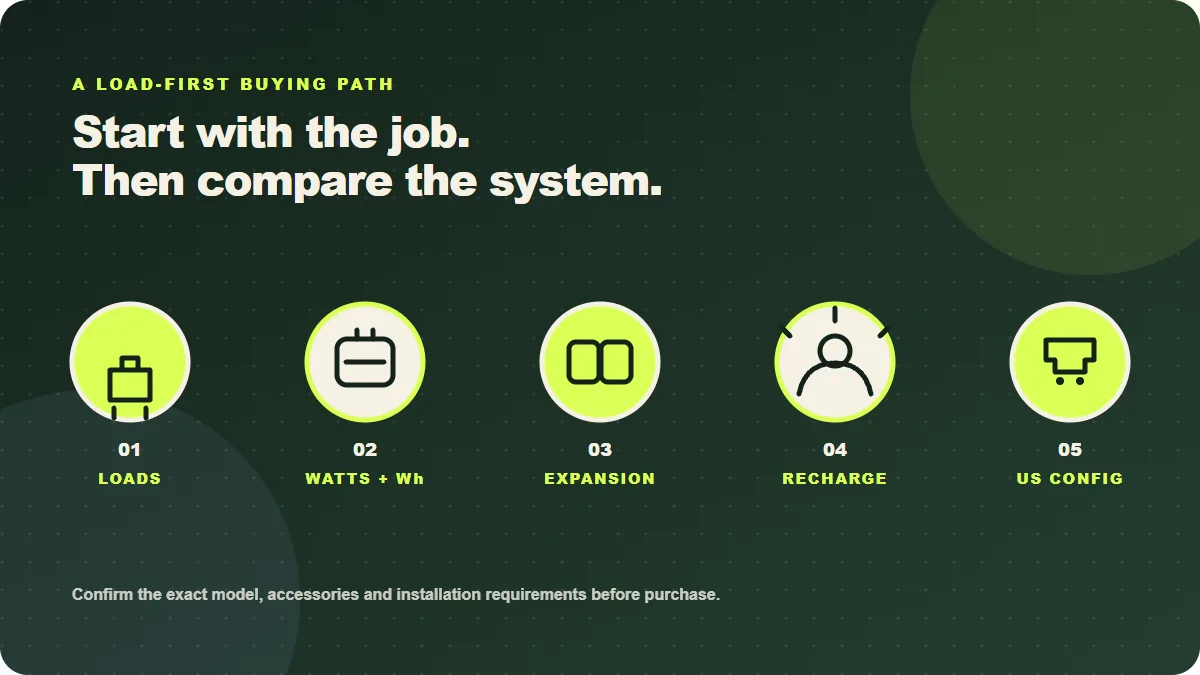
Plan the recharge route before the outage
Wall charging is the baseline, but an outage can also remove that source. Confirm the supported solar input range, connector type, panel voltage and current limits, and realistic production in the place where the panels will be used. Cloud, shade, season and panel angle all affect the energy delivered.
If vehicle charging or another backup source matters, verify the required cable and operating mode for the exact model. Recharge performance should be judged against the daily energy you need, not only the fastest possible charging claim.
Confirm the US version and purchase contents
Before checkout, confirm that the selected configuration is the United States version, that the outlet and voltage match the intended use, and that the box includes the cables and accessories you expect. Check shipping eligibility, warranty terms and the local support route.
Also confirm whether solar panels, expansion batteries, transfer equipment or installation hardware are separate purchases. The right BLUETTI US power station is the exact configuration that fits your load, recharge plan and ownership setup, not simply the unit with the largest advertised capacity.
Evidence note
This buying framework uses general electrical planning and BLUETTI US product coverage. Exact specifications, included accessories and local requirements must be confirmed for the selected model before purchase.
Check current configurations
Compare BLUETTI US power stations
Use the store listing to confirm model specifications, included equipment and current US availability.
Some links to manufacturer stores are commercial. We may earn a commission at no extra cost to you. Read the disclosure.