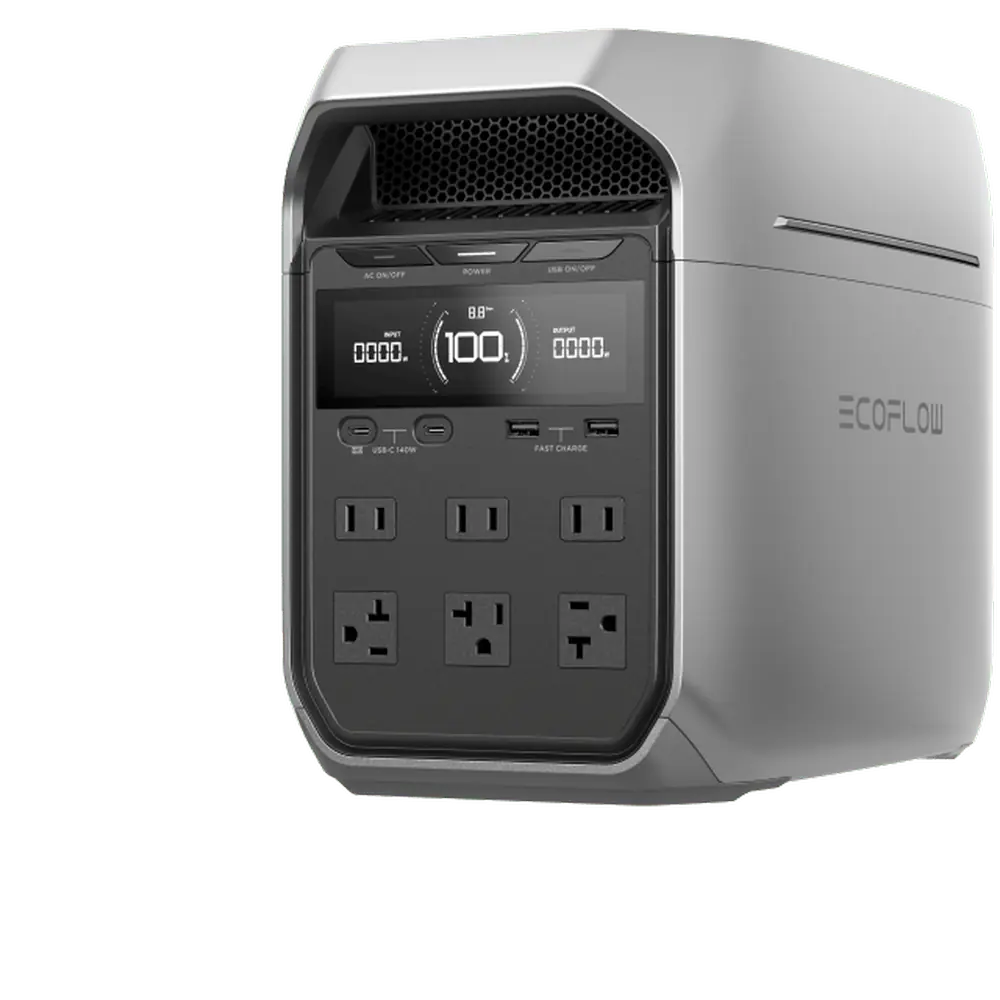
The EcoFlow DELTA 3 Plus is a 1,024Wh portable power station with a 1,800W AC inverter, two 500W solar inputs and a path to roughly 5kWh through compatible extra batteries. On paper, it is one of the more flexible products in the crowded 1kWh class.
The purchase decision is less clean than the spec sheet. Independent reviews broadly praise charging, portability and ports, but some high-load tests found fan and temperature behavior worth checking. This review keeps those findings separate from EcoFlow's claims.
Product identity and what this review is
This is a desk review of the US-market DELTA 3 Plus, model EF-DL-H10-4. EcoFlow's manual gives a launch date of November 30, 2024 and a five-year warranty. [1] It is the standalone station, not a solar-generator bundle.
We did not test a unit. Specifications come from EcoFlow's manual and US product page; performance observations come from named independent reviews. [1][2][4][5][6][7][8]
EcoFlow DELTA 3 Plus specifications
| Specification | Published detail | Source |
|---|---|---|
| Model / market | EF-DL-H10-4; US version used as manual example | [1] |
| Rated capacity | 1,024Wh, 51.2V 20Ah | [1] |
| Battery chemistry | LFP / LiFePO4 | [1][2] |
| AC output | 1,800W total, 3,600W surge; up to 2,200W for supported devices with X-Boost | [1][2] |
| AC input | 100–120V, 15A for US/CA; 1,500W maximum charging input | [1][2] |
| Solar input | Two XT60 ports, 11–60V and 500W each, 1,000W total | [1] |
| Main outputs | 6 AC outlets, 2 USB-C at 140W each, 2 USB-A at 36W each, car socket, 2 DC5521 | [1][2] |
| Weight / size | Approx. 12.5 kg / 27.6 lb; 202 × 397.6 × 283.6 mm | [1] |
| Cycle claim | At least 80% capacity after 4,000 cycles | [1][2] |
| UPS | Listed at under 10ms | [2] |
| Expansion | Compatible batteries can take the system to about 5kWh via the specified XT150 cable | [2] |
| Warranty | Five years | [1][2] |
The IP65 rating applies to the battery pack, not the complete station. The manual still requires dry, ventilated use and gives specific charging and discharging temperature limits. [1][2]
Price and availability snapshot
On November 3, 2026, EcoFlow's US page showed the basic unit at $719, reduced from $799, while the standalone listing displayed "Out of Stock." A 220W solar bundle was $919, reduced from $1,099. These were snapshots, not price guarantees. [2]
The standalone unit may be unavailable while bundles remain listed. Compare included items because a panel, extra battery, bag or generator changes the package's value.
Charging performance
EcoFlow rates the wall charger at 1,500W and claims a 56-minute full charge. SGS certified the DELTA 3 Plus under its fast-and-safe-charging program in 2024. [2][3] The Solar Lab recorded a 55-minute full charge, while TechRadar called fast charging a main strength. [4][7]
The two solar inputs are the more distinctive feature. EcoFlow supports up to 1,000W of solar across two MPPT controllers. Most direct competitors in this capacity class publish lower solar ceilings: Anker SOLIX lists 600W for the C1000 Gen 2, and Jackery lists a 400W maximum for the Explorer 1000 v2. [10][11]
Those ceilings do not mean every buyer will see 1,000W. Panel rating, voltage, shade, angle, temperature and controller limits reduce real output. The advantage matters only with enough compatible panels and space to deploy them.
Real-world performance and efficiency
Trusted Reviews ran a 1,000W heater for almost one hour and calculated about 87% efficiency from 888Wh consumed; results at 500W and 200W were similar. [6] This measures delivered energy rather than repeating a manufacturer runtime example.
The Solar Lab tested a 1,573W load. After cooling, the unit delivered 32 minutes at about 82% efficiency. [7] That is respectable for a compact inverter, though the test exposed the thermal concern below.
TechRadar used the station as a home-office UPS and reported that its router, modem, computer and connected equipment stayed powered through simulated outages. [4] That does not guarantee the 10ms transfer time will protect every sensitive device.
The fan and thermal conflict
How-To Geek reported a loud fan during a vacuum test and said the unit became warmer than expected. [5] The Solar Lab recorded internal temperatures of 138°F in one high-load run and 126°F in a later repeat, with inconsistent fan behavior. [7]
Other reviews are more positive. TechRadar described quiet operation. The Independent's 2026 test said the fan began only beyond roughly 1,500W, remained fairly quiet and did not overheat with mixed office loads. [4][8]
Public sources do not explain the difference. Firmware, ambient temperature, unit variation or test duration may matter, but those explanations are unverified. [1][2] Buyers planning long maximum-output runs should treat heat as unresolved rather than relying on the noise rating.
Pros and cons
Pros
- The 1,024Wh battery, 1,800W inverter and 13 ports cover many small and mid-sized loads. [1][2]
- Two 500W solar inputs exceed the Anker SOLIX and Jackery ceilings compared here. [1][10][11]
- Compatible batteries provide a route to roughly 5kWh. [2][10][11]
- Independent tests confirm fast wall charging, including one 55-minute result. [4][7]
- The five-year warranty and LFP cycle rating are competitive. [1][2]
Cons
- At 27.6 lb, it is heavier than the Explorer 1000 v2. [1][11]
- High-load fan and temperature reports conflict with quiet-operation messaging. [4][5][7][8]
- The standalone listing was out of stock on the review date. [2]
- Expansion needs a compatible battery and specified cable, both separate. [2]
- It has only three grounded AC outlets. [4]
Compared with 1kWh competitors
The closest comparisons are the Anker SOLIX C1000 Gen 2 and Jackery Explorer 1000 v2.
| Attribute | EcoFlow DELTA 3 Plus | Anker SOLIX C1000 Gen 2 | Jackery Explorer 1000 v2 |
|---|---|---|---|
| Capacity | 1,024Wh [1] | 1,024Wh [10] | 1,070Wh [11] |
| Rated AC output | 1,800W [1] | 2,000W [10] | 1,500W [11] |
| Maximum solar input | 1,000W [1] | 600W [10] | 400W [11] |
| Battery expansion | Yes, up to about 5kWh [2] | Not offered on Gen 2 [10] | Not supported [11] |
| Weight | 27.6 lb [1] | 24.9 lb [10] | About 23.8 lb [11] |
| AC recharge claim | 56 minutes [2] | 49 minutes in UltraFast mode [10] | About 1.7 hours normally; emergency mode differs [11] |
| Price snapshot | $719 sale / $799 regular [2] | $599.99 [10] | US price not captured for this review |
The C1000 Gen 2 wins on raw output and slightly easier carrying. DELTA 3 Plus answers with expansion and substantially more solar input. [1][2][10]
The Explorer 1000 v2 is lightest and has the most nominal capacity, but lower AC output, lower solar input and no battery expansion in this version. It better suits simple portable use than a growing solar setup. [11]
Wirecutter describes DELTA 3 Plus as cheaper than its upgrade pick but notes fewer grounded outlets and less power for its size. Read that against Wirecutter's exact comparison set and test date. [9]
Score and scoring method
Desk-review score: 8.2/10
The score is an editorial assessment of documented ownership fit, not a laboratory measurement.
| Criterion | Weight | Assessment |
|---|---|---|
| Capacity and appliance fit | 25% | Strong for the size, but still not whole-home storage. |
| Recharge flexibility | 25% | Best-in-class solar headroom among the three compared, with independently supported fast AC charging. |
| Evidence consistency and thermals | 20% | Good overall reports, but conflicting high-load fan and temperature results prevent a higher score. |
| Ports and portability | 15% | Excellent port selection; weight is average for a 1kWh LFP station. |
| Expansion and support | 15% | Useful expansion path, five-year warranty and a broad ecosystem, with configuration complexity. |
Our take
Our take: DELTA 3 Plus is the most interesting 1kWh EcoFlow model for a reader planning to add solar or a battery later. It is not the universal pick. Anker SOLIX C1000 Gen 2 is stronger when output and carry weight dominate; Jackery Explorer 1000 v2 better suits lighter plug-and-play use.
Our take: Thermal conflict is not a reason to dismiss the model, but it argues against buying solely for near-continuous maximum output. Seek a current demonstration, confirm returns and inspect recent firmware reports.
Verdict
The DELTA 3 Plus suits renters, campers, mobile workers and small-home emergency users who value fast recharge, many ports and expansion. It is less suitable for the lightest possible 1kWh unit, the highest continuous output or a hands-off whole-home installation.
Confirm the US bundle, cables, expanded footprint and budget, and ensure the most demanding appliance fits the published output and thermal limits.
Next step
Use the explainer in a buying decision
Evidence note
This is a desk review, not a first-hand test. Specifications come from EcoFlow's manual and US product page; performance observations are attributed to named independent publications. Price and availability were checked on November 3, 2026 and can change.
Source list
- [1]EcoFlow DELTA 3 Plus user manualEcoFlow · accessed 2026-11-03
- [2]EcoFlow DELTA 3 Plus portable power stationEcoFlow US · accessed 2026-11-03
- [3]EcoFlow awarded SGS Performance Tested Mark for DELTA 3 PlusSGS · accessed 2026-11-03
- [4]EcoFlow Delta 3 Plus portable power station reviewTechRadar · accessed 2026-11-03
- [5]EcoFlow Delta 3 Plus reviewHow-To Geek · accessed 2026-11-03
- [6]EcoFlow Delta 3 Plus reviewTrusted Reviews · accessed 2026-11-03
- [7]EcoFlow DELTA 3 Plus reviewThe Solar Lab · accessed 2026-11-03
- [8]Best portable power stations for 2026, tested by a tech expertThe Independent · accessed 2026-11-03
- [9]The 3 best portable power stations of 2026Wirecutter · accessed 2026-11-03
- [10]Anker SOLIX C1000 Gen 2 portable power stationAnker SOLIX US · accessed 2026-11-03
- [11]Explorer 1000 v2 basic informationJackery Support · accessed 2026-11-03