Quick verdict: choose the port map before the biggest wattage
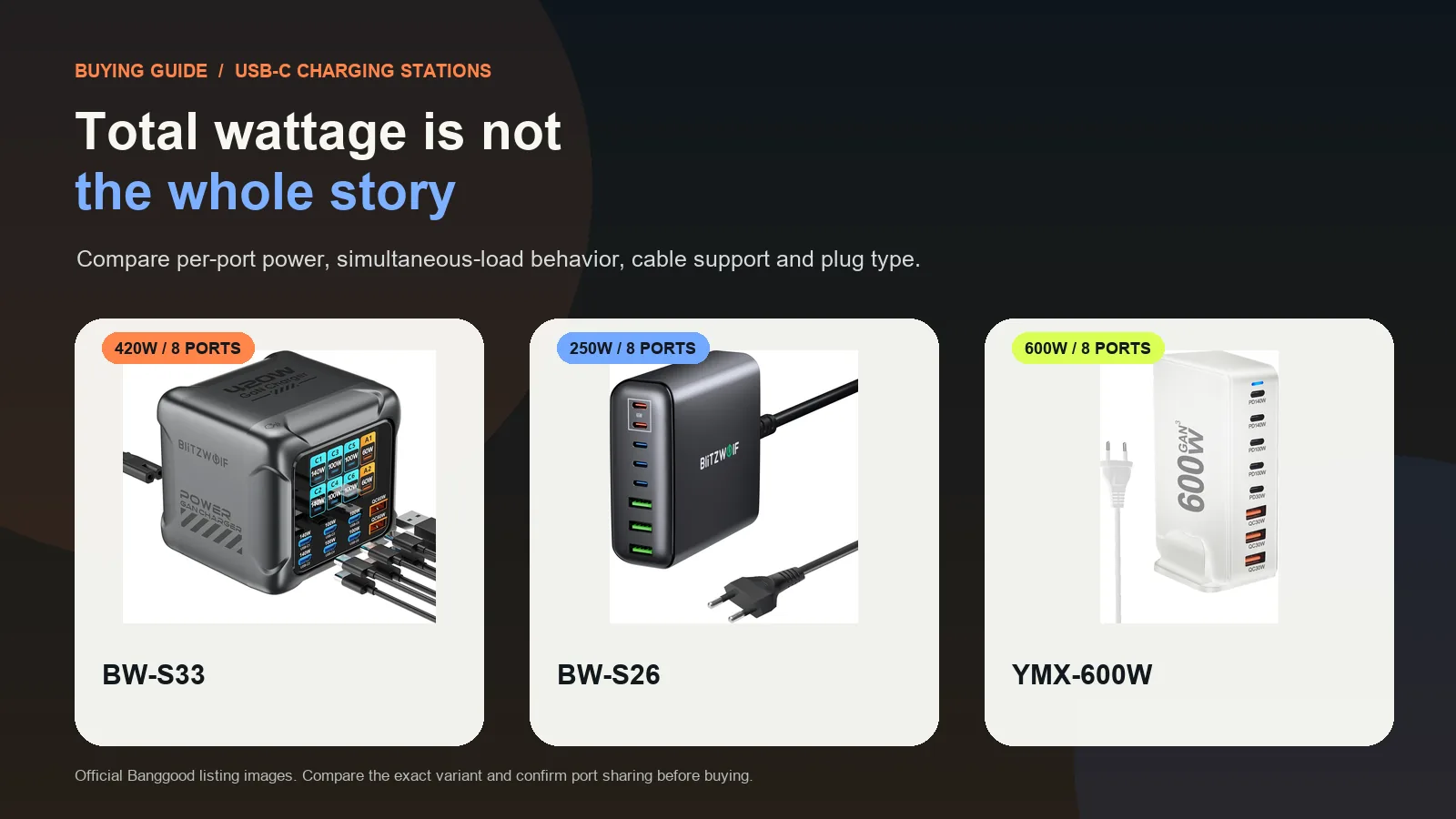
For a Banggood shopper who needs many USB-C ports, the strongest published-port-map in this shortlist is the BlitzWolf BW-S33. It lists 420W total output, two USB-C ports at up to 140W PD3.1, four USB-C ports at up to 100W and two USB-A ports at up to 60W. The checked partner-coupon page displayed €43.67 after coupon for the Black Single Charger and EU plug on November 20, 2026. [1][2]
The best value pick for a simpler device mix is the BlitzWolf BW-S26. Its listing advertises 250W total across five USB-C and three USB-A ports, and its checked partner-coupon page displayed €22.92 after coupon. [3][4]
The Bakeey YMX-600W is the highest advertised total-output product in this selected set, with eight ports and a checked after-code price of €28.65 for the selected variant. Its 600W headline still needs the same per-port and simultaneous-load scrutiny as every other multi-port charger. [5][6]
Evidence label: This is a desk-research buying guide based on Banggood listing claims and coupon pages. We did not measure output, heat, efficiency or cable performance.
What this guide covers
This guide is for readers comparing mains-powered USB charging stations on Banggood for a desk, home office, travel kit or multi-device household. It covers:
- the BlitzWolf BW-S33;
- the BlitzWolf BW-S26;
- the Bakeey YMX-600W;
- the power, cable, plug and marketplace factors that determine whether any of them fits.
It does not cover power stations with AC outlets, solar generators, power banks, wall-charger bricks or non-Banggood retailers. Those are different ownership decisions.
The price snapshot is in EUR and several checked variants are EU-plug. A USA-domain URL does not change that. Confirm the plug, country, currency, warehouse and included cable before ordering.
Quick picks
| Pick | Exact product | Best for | Primary trade-off | Checked coupon snapshot |
|---|---|---|---|---|
| Most detailed port map | BlitzWolf BW-S33 420W | Two high-power USB-C devices plus many smaller devices | Higher price than the BW-S26; EU plug in checked variant | €43.67 after coupon [2] |
| Best budget multi-port pick | BlitzWolf BW-S26 250W | Phones, tablets and a moderate laptop load | Lower total output and no published 140W pair in the product name | €22.92 after coupon [4] |
| Highest advertised total | Bakeey YMX-600W | Buyers who need eight ports and want to investigate the 600W claim | Higher number does not replace a detailed per-port table | €28.65 after coupon [6] |
The award names describe this selected Banggood subset. They are not universal category winners.
How the guide was selected
Banggood's catalog contains many overlapping chargers from different manufacturers. We started with the coupon feed you supplied and kept products that met four gates:
- The exact product identity is present in the listing.
- The listing or coupon page identifies the variant or plug.
- The product has a current future expiry on the checked coupon page.
- The description provides enough port detail to explain an ownership trade-off.
We weighted:
| Criterion | Weight | What it answers |
|---|---|---|
| Port map clarity | 30% | Which port can deliver what power? |
| Total output and sharing | 25% | Is the headline realistic for simultaneous devices? |
| Cable and protocol compatibility | 20% | Can the intended device actually negotiate the highest mode? |
| Variant and marketplace clarity | 15% | Are plug, warehouse, coupon scope and seller visible? |
| Price after coupon | 10% | Is the observed offer competitive for the published capability? |
One coupon in the supplied feed did not return a valid after-coupon result on its checked page, so it was removed from this guide. A feed entry is not enough by itself; the destination page must still make sense. [4]
Total watts are a budget, not a per-port promise
A 420W or 600W label describes the charger's published overall ceiling. It does not mean each port can output that number. The BW-S33 listing explicitly shows:
- C1 and C2: up to 140W;
- C3, C4, C5 and C6: up to 100W;
- A1 and A2: up to 60W.
Those are individual-port ratings. When several devices are connected, the charger allocates the shared power budget. The exact allocation table matters more than adding the largest numbers together and assuming every port stays there. [1]
This is why a “600W” charger can be less useful than a “420W” model for a specific load. If the 600W design puts more power into ports you never use, or allocates the high-power modes differently, the bigger headline may not improve your workflow.
Pick 1: BlitzWolf BW-S33 for the clearest published port map
Read the full BW-S33 desk review.
The BW-S33 is the most informative product in this subset because the listing image maps every port to a named maximum. The two 140W USB-C ports are the main reason to pay more than the BW-S26.
Who it fits
It fits a desk with:
- one or two compatible high-power laptops or power banks;
- a tablet or phone;
- several smaller USB-C accessories;
- an older USB-A device that still needs a standard port.
The digital display is useful because it can reveal when adding another device changes the charging state. Treat it as a guide, not a calibrated power meter.
What to verify
- The checked coupon variant is Black Single Charger, EU plug.
- The listing does not include a 140W-rated cable in that configuration.
- A compatible device and cable are required before the 140W mode can be used.
- The checked text does not provide a complete simultaneous-load allocation table.
- No independent thermal measurement was found in the sources reviewed for this article.
The BW-S33 is therefore a good desk-hub candidate, not a proven choice for maximum continuous load. Buyers who need a US plug should wait for the correct regional variant instead of using a travel adapter without confirmation.
Pick 2: BlitzWolf BW-S26 for a lower-cost eight-port desk charger
The BW-S26 publishes a 250W total and a different layout: five USB-C ports and three USB-A ports. Its checked partner page showed €22.92 after coupon. [3][4]
That price is less than half the checked BW-S33 after-code price. The trade-off is power flexibility. The product name does not promise the same pair of 140W PD3.1 ports, and the total ceiling is lower.
Who it fits
The BW-S26 is the more rational choice when the load is mostly:
- phones and tablets;
- one mainstream USB-C laptop;
- cameras, headphones and accessories;
- a few USB-A cables and low-power devices.
It is also the easier charger to recommend for a shared household charging area where nobody expects two 140W laptops.
What to verify
- Confirm the individual USB-C maximums, not only the 250W total.
- Check whether the 250W number is available across the intended combination of ports.
- Confirm that the checked EU variant matches your socket.
- Use a cable rated for the highest device mode you intend to use.
If the exact port breakdown matters, ask the seller for the current specification sheet before ordering. A product name can identify the family without explaining every simultaneous combination.
Pick 3: Bakeey YMX-600W for the highest advertised total
The YMX-600W has eight ports, split as five USB-C and three USB-A in the listing title. The checked coupon page displayed €28.65 after coupon for the Black EU-plug variant. [5][6]
The headline is attractive because 600W is higher than the other two picks, while the after-code price is relatively low. That combination should trigger more verification, not less.
What the headline does not answer
- Which exact USB-C ports can deliver the high-power modes?
- What are the individual cable and device requirements?
- How much power remains for the other ports during simultaneous use?
- Is the 600W total sustained, short-term or a theoretical sum?
- Does the charger use the same plug and input standard as the checked variant?
The checked sources do not provide a port-by-port table equivalent to the BW-S33's published image. A buyer should obtain that table from the seller before treating the YMX-600W as a true 600W workstation hub.
Who it may fit
It may fit a buyer who can verify the port map and wants an inexpensive eight-port charger for mixed devices. It is not the automatic winner merely because the total is larger.
What to ask before paying
A marketplace listing is a starting document. For any of these chargers, send the seller a short list of questions and keep the answer with the order record:
- What is the maximum output of each named port when used alone?
- What is the exact output allocation when all intended ports are occupied?
- Does the charger support the USB Power Delivery profile required by the target laptop?
- Does the package include a cable rated for 100W or 140W?
- Which plug and warehouse will ship for the selected country?
- Which party provides the warranty, and how does the return route change by warehouse?
- Does the listing show the model number, dimensions and weight?
If the seller cannot answer these questions, the buyer should treat the headline wattage as a marketing claim rather than a complete operating specification. This is especially important for a “600W” product where the individual-port table is not visible.
How much power do common devices need?
The correct charger size follows the devices, not the other way around:
- a phone may negotiate 20W to 65W depending on the model;
- a tablet often sits in a similar range;
- a thin laptop may use 45W to 100W;
- a performance laptop may request 140W or another manufacturer-specific profile;
- a high-capacity power bank may accept 100W, 140W or another rated input;
- headphones, watches and small accessories usually need much less.
Add the likely simultaneous load, then remember that the charger's total output is a ceiling. A 250W unit can be sufficient for one laptop, two phones and accessories. A 420W design becomes more useful when two high-power USB-C devices really need faster charging at the same time. A 600W claim only matters if the intended ports and devices can actually use that allocation.
A practical decision tree
Start with the most demanding device:
- If it needs a 140W-class profile and another device may need the same, inspect the BW-S33 first.
- If the highest device is a mainstream laptop and cost matters, start with the BW-S26.
- If the YMX-600W is cheaper after code, request its per-port table before choosing it.
- If only one laptop needs fast charging, a smaller single-port travel charger may be more sensible.
- If the devices do not need USB-C PD, a simpler USB-A hub can be sufficient.
That sequence prevents a buyer from paying for a large total ceiling that the actual devices cannot use.
Why USB-C port count is not enough
Three chargers can all have six USB-C ports and behave very differently.
The important questions are:
- Which ports support PD3.1?
- Which ports support 140W, 100W, 65W or 30W?
- Do high-power ports share a controller?
- Does adding a phone to a high-power port reduce a laptop's charge?
- Which cable capability is required?
- Does the charger support PPS, QC or another protocol needed by the device?
For a laptop, USB-C PD is often the deciding protocol. For a phone, proprietary fast charging may rely on PPS or another standard. For older devices, USB-A and QC support remain useful.
Match the exact device and cable, then treat the total wattage as the budget available to the group.
Cable support is part of the charger
A charger cannot negotiate a power mode that the cable cannot carry. A 140W claim needs a compatible cable and receiving device. A 100W port may be limited by a thin or older cable. A display can show a low value because the cable, device temperature or battery state is the limit.
Before buying, list:
- The highest-power device.
- Its maximum accepted USB-C power.
- The cable you will use.
- The number and type of other devices connected at the same time.
- Whether the charger page publishes those combinations.
If the listing does not answer those points, the safest approach is to buy the lower-cost charger for the confirmed workload rather than pay for a headline mode you cannot verify.
Plug, voltage and marketplace checks
Banggood sells across regions. The checked BW-S33, BW-S26 and YMX coupon variants are EU-plug listings with CN warehousing. The page can live on a USA domain and still show EUR and EU hardware. [2][4][6]
Before checkout:
- confirm the plug type in the selected variant;
- confirm the destination country;
- confirm the warehouse and delivery estimate;
- check whether tax and import charges are included;
- confirm the return address and who pays return shipping;
- identify the manufacturer and model on the order summary.
The charger input is advertised as 100–240V on the BW-S33 product image. That broad input does not make an EU plug safe or convenient in a US socket without the correct approved connection. The plug and local electrical requirements still matter.
Banggood coupon provenance
The deals used in this guide are partner codes. They appeared on Banggood coupon-transfer pages, but they came through an affiliate feed and were not completed through a test checkout. The site labels them separately from public brand codes.
The observed prices are:
- BW-S33: €43.67 after coupon;
- BW-S26: €22.92 after coupon;
- YMX-600W: €28.65 after coupon for the checked selected variant.
The coupon pages showed November 30, 2026 end dates at the time of checking. Reconfirm the selected item and plug before paying. A price after coupon on one variant is not a storewide promise. [2][4][6]
Scenario recommendations
Choose the BW-S33 if:
- two USB-C devices may need 140W-class charging;
- you want the clearest published port map;
- a per-port display helps you manage a crowded desk;
- the EU plug and current coupon scope fit your location;
- you accept that maximum simultaneous performance remains unmeasured.
Choose the BW-S26 if:
- price is more important than 140W ports;
- phones, tablets and a mainstream laptop define the workload;
- eight ports are useful but a smaller total output is acceptable.
Choose the YMX-600W only after verification if:
- the 600W headline is the main attraction;
- you can obtain a detailed individual-port and sharing table;
- the selected EU variant and warehouse are correct;
- the final delivered price remains lower than the alternatives.
Choose none of them if:
- you need a US plug and no correct regional variant is confirmed;
- you expect a battery or AC output;
- you require independent thermal and efficiency measurements;
- the charger will run unattended in a poorly ventilated enclosure;
- the listing does not identify the manufacturer or exact model.
Alternatives outside charging stations
A single-port Gallium Nitride (GaN) wall charger is smaller and may be better for one laptop. A power bank is appropriate when mobility rather than a desk hub matters. A portable power station is the next category when you need AC output or battery storage.
Do not buy an eight-port charger only to use two ports. The extra hardware, cable clutter and higher price are not automatically useful.
FAQ
Is a higher total wattage always better?
No. Per-port power, simultaneous-load allocation, cable support and device compatibility determine whether the extra total capacity helps your devices.
Can I use any USB-C cable with a 140W port?
No. Use a cable rated for the required power and current, and confirm that the device accepts the same PD profile.
Are these Banggood prices guaranteed?
No. They are dated snapshots from partner-coupon pages checked November 20, 2026. Prices, stock and eligibility can change.
Why are EU plugs shown on a USA-domain URL?
Banggood uses regional storefront paths, but the selected product variant and browsing currency can still be EU-based. Always inspect the variant selector and plug field.
Can a 600W charger run 600W on every port?
No. Total output and per-port output are different ratings. Ask for the port table and simultaneous-load conditions.
Do I need a power meter?
A power meter is useful if you need to verify negotiated watts, cable limits or sharing behavior. The charger's display may be helpful but is not a calibrated test instrument.
Can I leave a charging station plugged in all day?
Follow the manufacturer's instructions and keep it ventilated. Do not cover it, daisy-chain unsafe extensions or ignore abnormal heat, smell or cable damage.
Update note
This guide was checked on November 20, 2026. Product claims, coupon prices and variants can change. Confirm the exact manufacturer model, plug, included cable, warehouse and after-code cart total before purchase.
Next step
Use the explainer in a buying decision
Evidence note
This is desk research checked November 20, 2026. Selection is based on seller-published port counts, output claims, coupon pages and variant scope. No charger was lab-tested. Prices are marketplace snapshots and may change.
Source list
- [1]BlitzWolf BW-S33 420W eight-port charging stationBanggood · accessed 2026-11-20
- [2]Banggood partner-coupon page for BW-S33Banggood · accessed 2026-11-20 · Displayed €43.67 after coupon for Black Single Charger / EU plug on November 20, 2026.
- [3]BlitzWolf BW-S26 250W eight-port charging stationBanggood · accessed 2026-11-20
- [4]Banggood partner-coupon page for BW-S26Banggood · accessed 2026-11-20 · Displayed €22.92 after coupon on November 20, 2026.
- [5]Bakeey YMX-600W eight-port charging stationBanggood · accessed 2026-11-20
- [6]Banggood partner-coupon page for Bakeey YMX-600WBanggood · accessed 2026-11-20 · Displayed €28.65 after coupon for the checked selected variant.
- [7]About BanggoodBanggood · accessed 2026-11-20