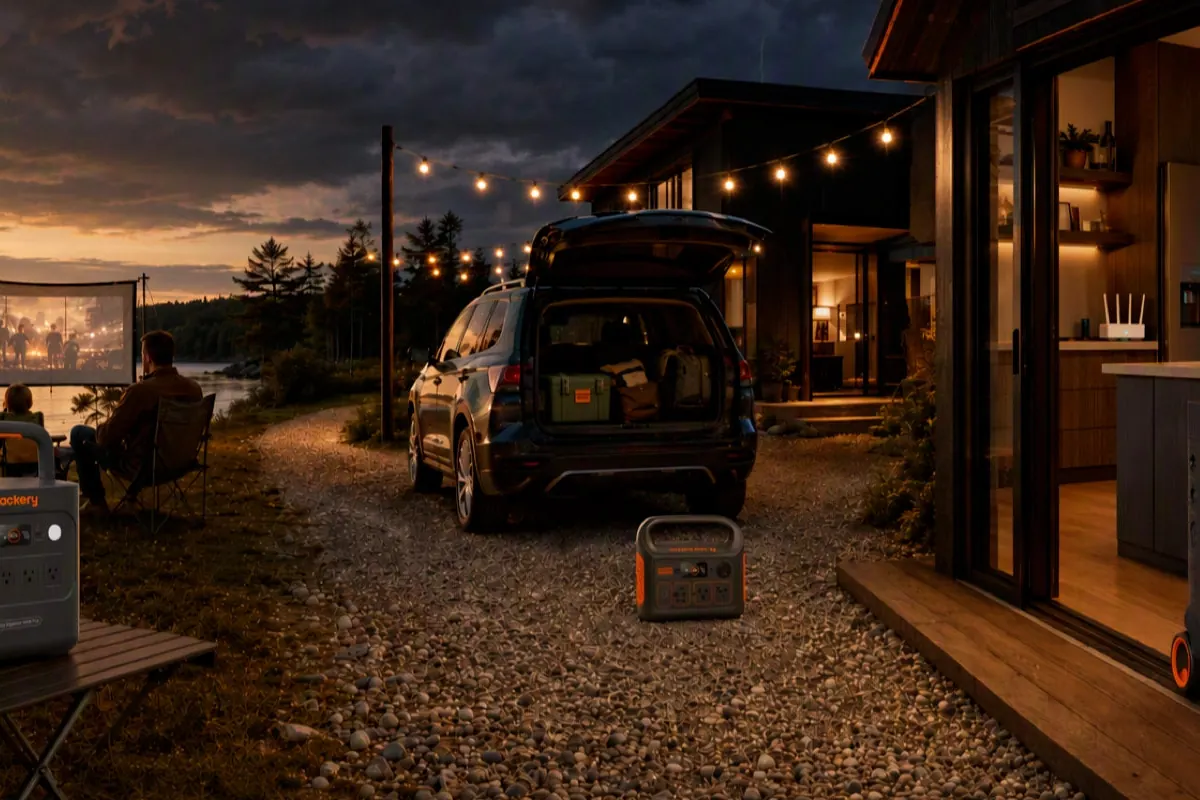
Jackery's range can look deceptively simple because many products share the Explorer name. In practice, fixed-capacity v2 stations, expandable HomePower systems and older Plus models differ in output, solar input, app support and battery compatibility.
This guide narrows the US catalog to three current, verifiable choices. Prices are snapshots from November 3, 2026 and can change.
Start with the job, not the watt-hour number
Write down what must run, for how long and at what startup demand. A laptop, router and phone charger need far less inverter capacity than a kettle, pump or power tool. A refrigerator cycles between high and low demand, while a heater may hold its full rating for hours.
Then decide where the station will live. A unit carried into a tent needs different proportions from one parked beside a refrigerator or loaded into a van. Weight, handle shape, outlet layout and charging noise become part of the product.
Jackery selection matrix
| Tier | Model | Verified specification | Best-fit buyer | US price snapshot |
|---|---|---|---|---|
| Portable 1kWh | Explorer 1000 v2 | 1,070Wh; 1,500W rated, 3,000W surge; 400W solar; 23.8 lb [1][2] | Camping, remote work and light outage backup | $589 [1] |
| Portable 2kWh | Explorer 2000 v2 | 2,042Wh; 2,200W rated, 4,400W surge; 400W solar; 39.5 lb [3][4] | Vans, deeper camping trips and larger appliance loads | $999 [3] |
| Expandable home-oriented | HomePower 2000 Plus v2 | 2,048Wh; 2,400W rated, 4,800W surge; 800W solar; expansion to 12kWh; 41.45 lb [5][6] | Buyers who may add batteries for longer outages | $1,549, reduced from $1,889 [5] |
The table uses battery-only prices. Solar panels, expansion packs and transfer equipment are usually separate.
Explorer 1000 v2: the carry-first choice
Explorer 1000 v2 is the easiest of the three to move and store. Its 1,070Wh capacity and 1,500W output support laptops, cameras, lights, routers and many small appliances. Jackery lists two AC outlets, a 100W USB-C port and a 30W USB-C port on the US configuration. [1][2]
Independent testers repeatedly highlight portability. OutdoorGearLab measured about 910Wh usable through the AC output, while The Solar Lab calculated 87.5% efficiency under a near-maximum load. Those results are strong enough for a compact station, but the 1,500W ceiling remains below the EcoFlow DELTA 3 Plus and Anker SOLIX C1000 Gen 2. [7][9][10][11]
Explorer 1000 v2 is also solar-limited. Its 400W ceiling is the same as the larger Explorer 2000 v2 but far below the 1,000W input available on DELTA 3 Plus. Buyers planning more than one large panel should not assume the Jackery ecosystem can absorb them. [1][10]
Buy this model when carrying comfort, simple controls and 1kWh capacity matter more than maximum solar, output or expansion.
Explorer 2000 v2: bigger loads, same solar ceiling
Explorer 2000 v2 roughly doubles storage to 2,042Wh and raises rated output to 2,200W. It weighs 39.5 lb, which is manageable for short carries but not for hiking. TechRadar called it comparatively light for its capacity and easy to use; OutdoorGearLab measured 1,740Wh delivered through the AC system. [3][4][8]
The model's greatest strength is its power-to-weight balance. It can run a griddle, induction burner, small fridge and assortment of electronics when the loads are managed. Its greatest weakness is the fixed 400W solar ceiling and no battery expansion. [3][4]
The AC fast-charge feature is useful before a trip, but do not treat the shortest published time as the default. OutdoorGearLab measured a 2.5-hour full charge, while The Solar Lab found the highest input was gated by Emergency Charging Mode. [4][8]
Buy it when 2kWh is the realistic ceiling, the unit will be moved rather than installed, and solar is a backup source rather than the main recharge plan.
HomePower 2000 Plus v2: the growth path
HomePower 2000 Plus v2 starts at 2,048Wh with 2,400W rated AC and 4,800W surge. It accepts up to 800W of solar and can expand to 12kWh with up to five compatible Battery Pack 2000 Plus v2 units. [5][6]
That expansion changes the ownership plan. The first purchase can cover a refrigerator, router and selected devices, while later batteries can extend outage runtime without replacing the main unit. The catch is model compatibility: older Battery Pack 2000 Plus units do not work with the new v2 system. [5]
HomePower's 18.8kg weight is lower than many expandable 2kWh systems, and Jackery lists a 10ms UPS rating. Those features make it more home-oriented than the fixed Explorer units. It still does not become a permanent whole-home battery; transfer equipment and installation planning remain separate questions. [6]
Buy it when expansion is plausible and the budget allows a complete system rather than just the base unit.
Who should not choose Jackery
Do not choose a fixed Explorer 1000 v2 or 2000 v2 if you already expect to need 4kWh or more during an outage. A HomePower system or a different expandable brand will often be a cleaner path than buying two unrelated stations. [3][5]
Do not choose Jackery for a high-input solar project. A 400W solar ceiling on the Explorer units is a hard limit. If multiple large panels and fast daylight recovery are central, compare products with 800W–1,000W or higher input. [1][3][10]
Do not choose a portable unit as a substitute for an installed home battery with permits, automatic circuit transfer and professional commissioning. Portable UPS output is not the same as whole-home backup.
Do not buy a solar bundle solely because its total panel wattage appears in the listing. Check whether the power station can accept that total, what connectors are included and whether the panels are wired in a compatible series or parallel arrangement. [1][2][3][4]
Common traps found in the evidence
Confusing rated output with surge
Explorer 2000 v2 lists 2,200W continuous and 4,400W surge, but independent tests observed a lower short-duration ceiling under their specific load. Match a motor's actual startup profile instead of designing around the largest surge label. [3][4][8]
Treating a fast-charge claim as the default
Explorer 2000 v2 uses an Emergency Charging Mode for its fastest published AC result. The normal charging path can be slower, and repeated high-speed charging may affect long-term battery treatment. [3][4][8]
Assuming expansion across Jackery generations
HomePower 2000 Plus v2 is compatible only with Battery Pack 2000 Plus v2 products. The similarly named older battery is not supported. Confirm model and generation before buying a secondhand battery. [5]
Underestimating solar downtime
Even an 800W HomePower input is a peak rating, not production in shade or cloud. Daily energy delivered to the battery can be far below the panel's label. Plan around seasons and weather rather than the fastest recharge day. [1][3][5]
Buying a weather-resistant battery as a weatherproof system
The manual may list protection for a battery pack or panel while leaving the full station unsuitable for rain. Keep the power station dry and ventilated unless the complete product page explicitly supports the environment. [1][3]
Purchase channel advice
Buy from Jackery's official store or a clearly identified authorized retailer. Confirm the exact model, color or bundle, voltage, included charging cables, solar adapters, shipping region and warranty. Jackery's extended warranty terms can depend on purchase channel. [1][3][5]
Inspect third-party marketplace listings for mismatched model names, missing accessories and imported voltages. For an expandable HomePower system, verify that the battery pack is the v2 version before checkout.
The US store snapshots on November 3, 2026 showed $589 for Explorer 1000 v2, $999 for Explorer 2000 v2 and $1,549 for HomePower 2000 Plus v2, with the HomePower page showing a $1,889 comparison price. [1][3][5]
Final checklist
- Add the continuous and startup watts for each appliance.
- Estimate the energy needed for one evening, 24 hours and multi-day outages.
- Decide whether 400W solar input is enough.
- Decide whether fixed or expandable capacity is more honest for your budget.
- Check AC outlet count, USB-C power and 12V output.
- Verify the exact battery-pack generation if expansion matters.
- Confirm warranty, return terms and purchase channel.
A Jackery product is the right answer only when those seven answers fit the specific model. It is not a universal recommendation.
Next step
Use the explainer in a buying decision
Evidence note
This is desk research, not a hands-on test. US products and prices were checked November 3, 2026. Manufacturer claims, independent measurements and editorial recommendations are kept separate.
Source list
- [1]Jackery Explorer 1000 v2 product pageJackery US · accessed 2026-11-03
- [2]Explorer 1000 v2 basic informationJackery Support · accessed 2026-11-03
- [3]Jackery Explorer 2000 v2 product pageJackery US · accessed 2026-11-03
- [4]Explorer 2000 v2 basic informationJackery Support · accessed 2026-11-03
- [5]Jackery HomePower 2000 Plus v2 product pageJackery US · accessed 2026-11-03
- [6]HomePower 2000 Plus v2 basic informationJackery Support · accessed 2026-11-03
- [7]Jackery Explorer 2000 v2 reviewOutdoorGearLab · accessed 2026-11-03
- [8]Jackery Explorer 2000 v2 reviewThe Solar Lab · accessed 2026-11-03
- [9]Jackery Explorer 1000 v2 reviewThe Solar Lab · accessed 2026-11-03
- [10]EcoFlow DELTA 3 Plus user manualEcoFlow · accessed 2026-11-03
- [11]Anker SOLIX C1000 Gen 2 product pageAnker SOLIX US · accessed 2026-11-03