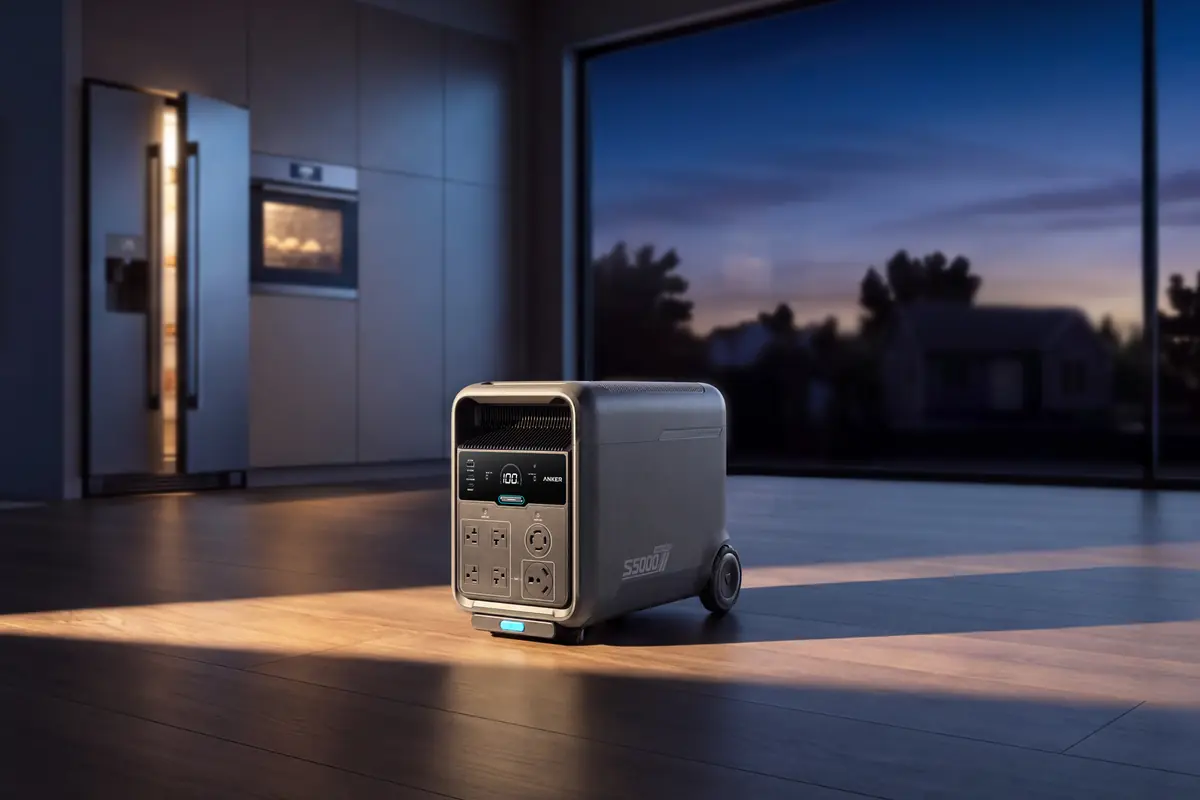
Anker SOLIX sits inside Anker Innovations, a company with a long history in charging and power conversion. Its energy range starts with compact 1kWh stations and extends to expandable home-oriented systems.
The buying decision should begin with two questions: how much power is needed now, and whether the battery must grow later. Anker sells strong options on both sides, but the C1000 Gen 2 and F2000 do not play the same role.
Match the system to the job
List continuous watts, startup surge and runtime for each appliance. Then decide whether the station will be carried, stored in a vehicle or kept near a refrigerator and network cabinet.
A compact 1kWh station is useful for laptops, lights, routers and short appliance runs. A 2kWh expandable system makes more sense when the buyer expects longer outages or may add a battery. A 3kWh-plus home-oriented unit introduces wheels, transfer hardware and installation discussions.
Anker SOLIX recommendation matrix
| Tier | Model | Verified starting specification | Best-fit job | US price snapshot |
|---|---|---|---|---|
| Compact 1kWh | C1000 Gen 2 | 1,024Wh; 2,000W rated, 3,000W peak; 600W solar; 24.9 lb [1] | Travel, remote work and short outages | $599.99 [1] |
| Expandable 2kWh | F2000 | 2,048Wh; 2,400W; 1,000W solar; expansion to 4,096Wh [2] | Longer outage backup with a growth path | Price not captured here |
| Larger home-oriented | F3000 | 3,072Wh; 3,600W; 2,400W solar; expansion to 24kWh [3] | Fridge, larger appliances and planned home backup | $1,899.99 [4] |
F3000 is heavy and has a suitcase-style wheeled design. It is not a larger version of the C1000 for casual carrying; it is a different ownership category. [3]
C1000 Gen 2: compact and fast
C1000 Gen 2 is the clearest travel-first choice. It weighs 24.9 lb, delivers 2,000W continuous and has five AC outlets plus two 140W USB-C ports. Its 49-minute UltraFast charge requires activation in the app. [1]
Independent tests support the output and fast charging. MacRumors found it could run a full Mac workstation for almost a day with periods of rest; The Technology Man measured 907Wh delivered at 1,000W and a 47-minute full charge. [5][6][7]
The main trade-off is fixed capacity. Unlike the original C1000, Gen 2 does not support an expansion battery. The buyer should be comfortable with 1,024Wh as the ceiling. [1]
Charging noise also matters. MacRumors and CHIP found fast charging noticeably loud. A user who sleeps next to the station should plan around slower charging or a different location. [5][8]
Buy C1000 Gen 2 when carrying size, output and turnaround time matter more than expansion.
F2000: portable power with a growth path
F2000 provides 2,048Wh, 2,400W AC output and up to 1,000W solar input. It can be expanded to 4,096Wh with one compatible battery and offers 12 outputs. [2]
That combination makes it more flexible than C1000 Gen 2 without moving immediately to the 91.5 lb F3000. It is still a substantial object, so check the exact weight and dimensions before treating it as a van-portable unit.
F2000 is the better Anker starting point when the buyer expects a refrigerator plus network gear for a longer outage or wants the option of adding capacity later. A current US price was not captured in this guide, so compare the complete battery and solar configuration at checkout.
F3000: plan the home setup first
F3000 starts with 3,072Wh and 3,600W output, plus two solar inputs totaling up to 2,400W. It can expand to 24kWh with multiple batteries and is designed around wheeled movement and larger home loads. [3]
This is not a plug-and-play whole-home battery. The page describes transfer switches, double-voltage hubs and installation-related configurations as separate products or decisions. [4]
Use F3000 when the appliance list includes larger loads and the buyer has a place to store and move a 91.5 lb unit. Confirm the transfer method, electrician requirements and local rules before buying the station alone.
What the UPS rating does and does not mean
C1000 Gen 2 and the larger F series publish fast UPS switchover times. That makes them useful for routers, computers and selected network equipment during a sudden outage. A low millisecond number is not enough on its own to certify a medical device, server or building system.
Check whether the connected device tolerates the published transfer time, whether the station produces the required waveform and whether the manufacturer permits UPS use for that equipment. Test the actual load before relying on it during an emergency. The UPS function also consumes battery and should not be confused with a permanently installed transfer switch.
Who should not choose Anker SOLIX
Do not buy C1000 Gen 2 if expandability is already a firm requirement. Choose F2000 or a competitor with the exact battery family you need. [1][2]
Do not buy the compact model for long continuous heating or high-load work. The 1kWh battery drains quickly and the Thermal test from The Technology Man shows why ventilation and duty cycle matter. [6]
Do not treat a 10ms UPS as a universal guarantee for servers or medical devices without checking the device's own requirements. UPS compatibility is a system question.
Do not buy F3000 merely because it has a larger battery. Its wheeled form and home-oriented configuration may be unnecessary for camping or a small apartment. [3]
Do not buy an expandable unit without pricing the batteries and cables needed for the realistic outage. A lower base-unit price can become the more expensive system once the required expansion pack is included.
Common traps
Assuming the SOLIX name means expansion
C1000 Gen 2 does not accept an expansion battery; F2000 does. Check the exact generation and product page rather than the sub-brand. [1][2]
Expecting UltraFast by default
The 49-minute claim requires the correct cable, suitable battery temperature and app-enabled UltraFast mode. Standard charging is slower and likely quieter. [1][5]
Buying the largest solar panel without checking voltage
C1000 Gen 2 has a 600W, 60V maximum solar input, and compact low-voltage panels may not reach that power. Match total voltage, current and connector to the station. [1][6]
Treating a compact station as a whole-home battery
Portable stations can bridge an outage and run selected devices. They do not replace a permitted home battery with automatic circuit-level transfer unless a designed system is installed.
Ignoring noise and heat
UltraFast charging is loud in independent tests, and a high-output heater test caused a thermal shutdown when the appliance was close to the unit. Keep ventilation clear and match continuous load to the rating. [5][6][8]
Purchase channel advice
Purchase through Anker SOLIX's US store or a clearly identified authorized retailer. Confirm model number, generation, US voltage, included AC cable, selected solar bundle, warranty and return terms.
Current US snapshots on November 3, 2026 showed C1000 Gen 2 at $599.99 and F3000 at $1,899.99. F2000's price was not captured. [1][4]
Final checklist
- What daily energy and peak output does each essential load require?
- Is 1kWh enough, or is a 2kWh expandable model the better floor?
- Does the buyer need the smallest possible unit or a future battery path?
- Will UltraFast charging noise be acceptable in its location?
- Are the solar panels within the voltage and current limits?
- Does a home-oriented unit require a transfer switch or installer?
- Is the exact generation confirmed in the cart and order confirmation?
Use those answers to choose between C1000 Gen 2, F2000 and F3000. The name alone cannot make that decision.
Next step
Use the explainer in a buying decision
Evidence note
This guide is desk research, not a hands-on test. US specifications and prices were checked November 3, 2026; configurations and promotions can change.
Source list
- [1]Anker SOLIX C1000 Gen 2 product pageAnker SOLIX US · accessed 2026-11-03
- [2]Anker SOLIX F2000 product pageAnker SOLIX US · accessed 2026-11-03
- [3]Anker SOLIX F3000 product pageAnker SOLIX US · accessed 2026-11-03
- [4]Anker SOLIX F3000 collection and pricesAnker SOLIX US · accessed 2026-11-03
- [5]Review: Anker SOLIX C1000 Gen 2MacRumors · accessed 2026-11-03
- [6]Anker SOLIX C1000 Gen 2 reviewAndroid Authority · accessed 2026-11-03
- [7]Anker Solix C1000 Gen 2 im TestCHIP · accessed 2026-11-03
- [8]Record-breaking charge speed? Anker SOLIX C1000 Gen 2 reviewThe Technology Man · accessed 2026-11-03
- [9]EcoFlow DELTA 3 Plus user manualEcoFlow · accessed 2026-11-03
- [10]Jackery Explorer 1000 v2 basic informationJackery Support · accessed 2026-11-03