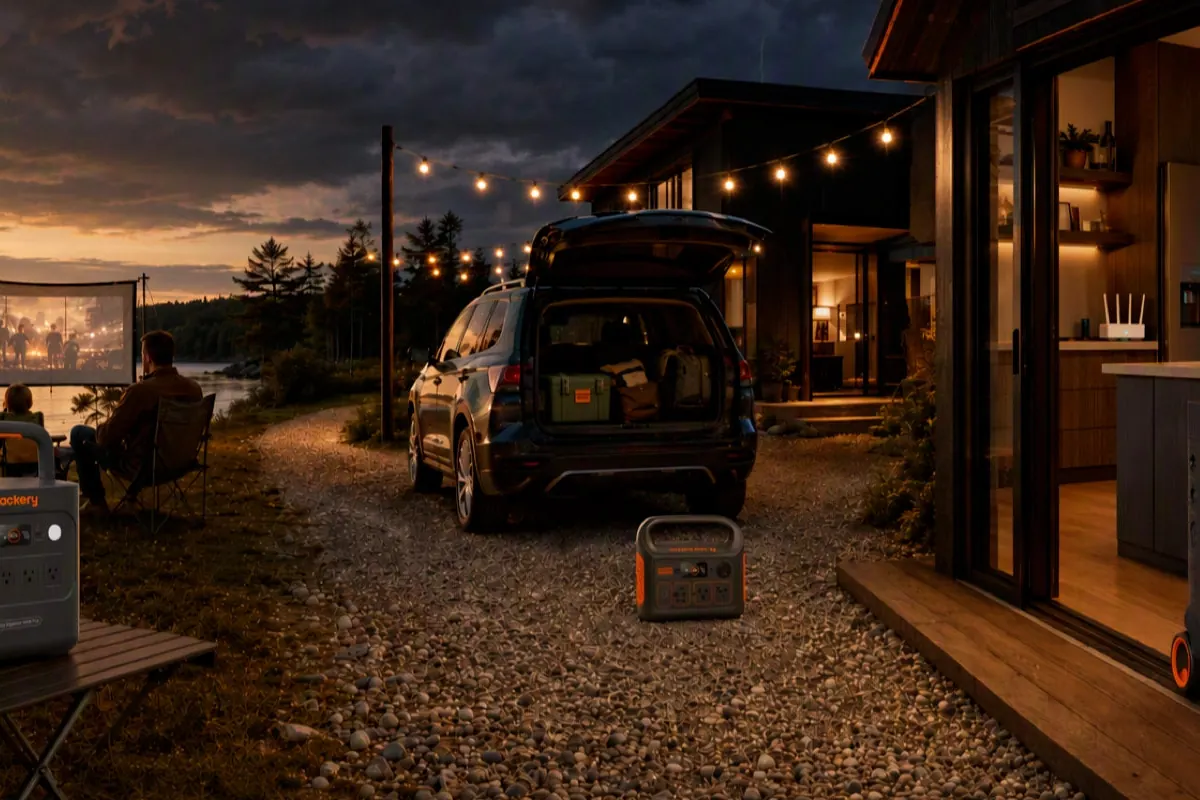
Jackery helped turn the portable power station from a specialist outdoor product into a mainstream consumer device. Its current catalog includes compact camping stations, solar panels, larger units for vans and job sites, and expandable products intended for short home outages.
The brand has a simpler public story than some competitors: portable power first, solar integration second, home backup later. That focus explains both its strengths and its limits.
Origin: a battery brand built for the outdoors
Jackery says it was established in 2012 by battery-technology innovators who wanted to make renewable energy accessible for outdoor life. Its US operating company, Jackery Inc., is based in Fremont, California. [1][5]
The corporate structure is international. Jackery is a brand of Shenzhen Hello Tech Energy Co., Ltd., also called Hello Tech, which says it was founded in 2011 and now describes itself as a publicly listed company with a Shenzhen base and international offices. Forbes reported in 2022 that Jackery was co-founded by a former Apple senior engineer and that an early battery product for the iPhone inspired the Jackery name. [3][4]
Those facts coexist with a marketing history that often describes Jackery as California-born. The brand identity grew in California and the United States, while the parent company's engineering, manufacturing and public-company structure are Chinese. A full ownership discussion should say both rather than choosing whichever origin sounds simpler. [1][3][4]
From Explorer to SolarSaga
Jackery's own timeline places the first Explorer lithium portable power station in 2015 and the first SolarSaga solar panel in 2018. The pairing mattered: a battery became a small solar system when a compatible folding panel was added. [2]
By 2020, Jackery was marketing combined "solar generator" kits rather than only standalone stations. The company then expanded through the Explorer Pro and Plus families, added larger home-oriented products and developed a mobile app for monitoring and settings. [2][5]
Its 2020s catalog no longer follows one clean tier. There are fixed-capacity Explorer v2 models, expandable Plus systems, wheeled high-capacity units and products described as HomePower systems. Model names that look adjacent may differ in expansion support, output and solar input, so the brand name cannot replace a specification check. [6][7][8]
How the product ladder works
Three verified models show the current range:
| Job | Model | Published starting point | US price snapshot |
|---|---|---|---|
| Portable 1kWh power | Jackery Explorer 1000 v2 | 1,070Wh; 1,500W rated, 3,000W surge; 400W maximum solar [6] | $589, checked 2026-11-03 [6] |
| Larger fixed-capacity power | Jackery Explorer 2000 v2 | 2,042Wh; 2,200W rated, 4,400W surge; 400W maximum solar; 17.9kg [7] | $999, checked 2026-11-03 [7] |
| Expandable home-oriented system | Jackery HomePower 2000 Plus v2 | 2,048Wh; 2,400W rated, 4,800W surge; expansion to 12kWh [8] | $1,549, reduced from $1,889, checked 2026-11-03 |
The ladder reveals a deliberate trade-off. Explorer v2 products prioritize simple transport and fixed capacity. HomePower moves toward expansion and backup-oriented features but requires compatible Battery Pack 2000 Plus v2 units. Older expansion batteries are explicitly not compatible with the new HomePower model. [8]
Credibility: recognition versus outcome claims
Jackery has documented design recognition across generations, including Red Dot and iF awards listed in its company history. It also says more than 150,000 five-star reviews and eight million users support the brand. Those are company-published figures; they were not independently audited for this profile. [1][2]
Its "No. 1 solar generator brand" claim cites a 2026 Frost & Sullivan white paper based on cumulative sales volume and revenue through 2025. That is more specific than an unsourced slogan, but it measures commercial scale within a defined category. It does not prove that a given Jackery model has the best output, efficiency or warranty. [1]
Independent product tests are useful counterweight. OutdoorGearLab measured 1,740Wh delivered from the Explorer 2000 v2 against its 2,042Wh rating, about 84% through an AC outlet. That was described as within the normal range for battery stations, but it is not the same as the full rated capacity. [9]
The Explorer 1000 v2 also illustrates the difference between useful ownership and headline simplicity. The Solar Lab calculated 87.5% efficiency under a near-maximum load and found fast emergency mode, but noted that normal charging is slower and the 400W solar ceiling limits solar-first users. [10]
What Jackery does not do well
Jackery's fixed-capacity v2 models are easy to understand but cannot grow with a buyer's needs. The Explorer 1000 v2 and Explorer 2000 v2 do not support battery expansion in those versions. Buyers who later need a larger system must add another unit or replace the purchase. [6][7]
The solar ceiling is another repeated compromise. Both Explorer 1000 v2 and 2000 v2 list 400W maximum solar input, lower than several similarly sized competitors. That may not matter with one small panel, but it does matter for an off-grid user planning a larger array. [6][7]
The third boundary is feature depth. Independent reviewers praise the simple controls and compact designs, while noting limited outlets, app functions or expandability depending on the model. Simplicity is the product's appeal; it is not a substitute for whole-home transfer equipment or advanced energy management. [9][10]
Our take: where Jackery is strongest
Our take: Jackery is most credible for first-time portable-power buyers who value light weight, clear controls and a brand-supported solar accessory path. Its 1kWh and 2kWh Explorer units are easier to understand than a complicated expandable ecosystem.
Our take: The brand is less compelling for a buyer whose main goal is maximum solar input, battery expansion or whole-home automation. Those buyers should compare EcoFlow and Anker SOLIX systems, while still checking the exact model rather than treating one brand as universally superior.
Who should trust Jackery
Jackery is a sensible starting point for camping, van travel, mobile work and short outage backup where a compact station will be carried and stored rather than installed. Its Explorer product names are familiar, its accessory line is broad and its published specifications are easy to compare.
Trust the brand only after deciding whether fixed capacity is acceptable, how much solar input the trip really needs and whether an expandable system would cost less than buying twice. For a household circuit or permanent battery installation, use an electrician or installer and compare a complete home-energy system rather than a portable product alone.
Official site
Visit Jackery
Check current models, regional versions, bundles and availability at Jackery's official store.
Some links to manufacturer stores are commercial. We may earn a commission at no extra cost to you. Read the disclosure.
Evidence note
This brand story uses Jackery and parent-company publications, a founder interview and product specifications checked November 3, 2026. Sales, user and market-share statements remain company claims unless independently documented.
Source list
- [1]About Jackery USJackery · accessed 2026-11-03
- [2]About Jackery and company milestonesJackery Europe · accessed 2026-11-03
- [3]About Hello Tech and Jackery brand historyHello Tech · accessed 2026-11-03
- [4]The Apple of portable power devicesForbes · accessed 2026-11-03
- [5]Jackery US site informationJackery · accessed 2026-11-03
- [6]Jackery Explorer 1000 v2Jackery US · accessed 2026-11-03
- [7]Jackery Explorer 2000 v2Jackery US · accessed 2026-11-03
- [8]Jackery HomePower 2000 Plus v2 basic informationJackery Support · accessed 2026-11-03
- [9]Jackery Explorer 2000 v2 reviewTechRadar · accessed 2026-11-03
- [10]Jackery Explorer 1000 v2 reviewThe Solar Lab · accessed 2026-11-03