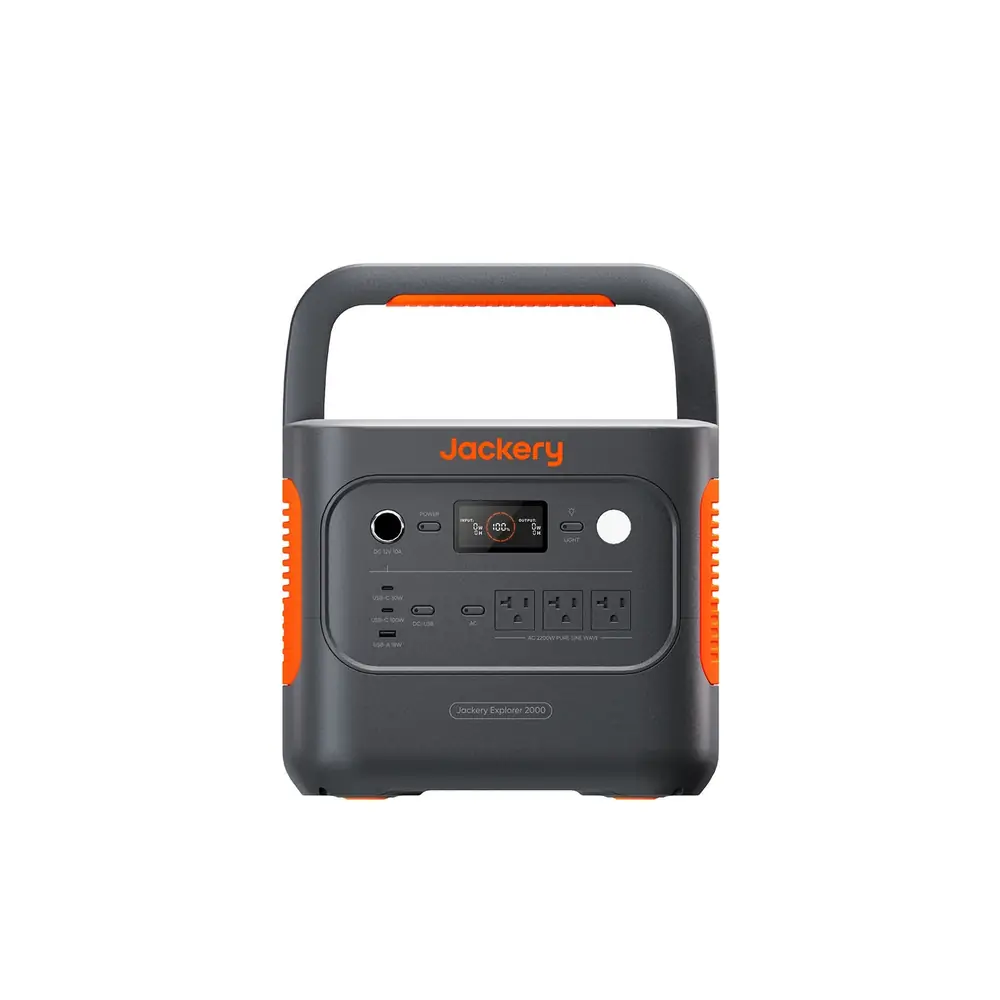
The Jackery Explorer 2000 v2 is a fixed-capacity 2kWh power station built for portability. Its 2,042Wh LiFePO4 battery, 2,200W continuous AC output and under-40lb weight make it substantially easier to move than many older 2kWh systems.
The main question is not whether it can run a campsite or short outage. It can. The question is whether its fixed capacity, modest solar ceiling and limited port set fit the way you will use it.
Product identity and evidence standard
This desk review covers the US-market Explorer 2000 v2, model JE-2000D. Specifications come from Jackery's product page and support documentation. Performance findings come from named independent reviews; we did not test a unit ourselves. [1][2][3][4][5][6][7]
Jackery lists a 3-year standard warranty plus a 2-year extension when the product is purchased through qualifying official or authorized channels. Buyers should confirm that condition on the final cart and order documents. [1][2]
Jackery Explorer 2000 v2 specifications
| Specification | Published detail | Source |
|---|---|---|
| Model | JE-2000D | [2] |
| Battery | 2,042Wh LiFePO4, 44.8V | [1][2] |
| Rated AC output | 2,200W total; 4,400W surge | [1][2] |
| AC outlets | 3 × 120V | [1][2] |
| USB | 1 × 100W USB-C, 1 × 30W USB-C, 1 × 18W USB-A | [1][2] |
| Other output | 12V car socket | [2] |
| AC charging | 1,800W maximum; about 1.7–2 hours claimed | [1][2] |
| Solar input | Two ports, 400W total, 16–60V operating range | [2] |
| Car charging | 11–16V, 8A maximum | [2] |
| Weight | 17.9kg / 39.5 lb | [1][2] |
| Cycle rating | 4,000 cycles to at least 70% capacity | [1][2] |
| UPS | Under 20ms | [2] |
| Expansion | Not supported on this model | [1] |
| Price snapshot | $999 on Jackery US, checked 2026-11-03 | [1] |
The solar voltage details matter. Jackery says the two DC ports are wired in parallel and requires matching panel models when both are used. The presence of two ports does not mean a buyer can freely mix a 100W panel and a 200W panel. [2]
Measured output and efficiency
OutdoorGearLab measured 1,740Wh delivered through the AC inverter from the 2,042Wh rating, about 84% of nominal capacity. It called that approximately average for its test group and still enough for multiple camping loads. [4]
The Solar Lab measured about 90% efficiency and a low idle draw of roughly 17W. In its tests, the inverter held the 2,200W continuous rating, while brief surge behavior reached about 3,100W rather than the 4,400W ceiling Jackery publishes. [5]
Those results are not necessarily contradictory. A surge rating describes a short maximum under particular conditions; a bench test can encounter protection limits before the maximum label. Buyers with a motor or pump should still use the appliance's measured startup demand rather than assuming the highest surge figure will always be available. [2][5]
nextpit measured 1,920Wh delivered after 2,141Wh was placed into the battery, about 89.6% efficiency. It praised the output and transport design but found the app less capable than competitors. [6]
Charging and solar performance
Jackery lists a 1.7-hour emergency recharge and a roughly 2-hour standard AC time depending on page and condition. OutdoorGearLab measured a full charge in 2.5 hours, while The Solar Lab found the 1,800W input gated behind an Emergency Charging Mode toggle. Without that mode, input sat closer to 1,300W. [1][2][4][5]
The practical lesson is to read the mode, outlet and temperature conditions attached to any charging time. The faster mode may be useful before a trip but is not the normal default in the evidence reviewed.
Solar is the larger constraint. The Explorer 2000 v2 accepts a maximum of 400W, far below the 1,000W solar input on the BLUETTI Elite 200 V2 and EcoFlow DELTA 3 Plus. A single 200W panel is likely to take most of a sunny day to replace a large portion of the battery, and clouds or poor angles extend the time. [2][8][9]
Portability and everyday use
At about 39.5 lb, the Explorer 2000 v2 is heavy for a backpack but reasonable for short carries between a car, tent, van or room. TechRadar described it as comparatively light for 2kWh and easy to use; The Independent similarly called it a practical camper-van compromise. [3][7]
The port set is less generous than the weight suggests. Three AC outlets, three USB ports and one car socket are enough for a small work setup or a few appliances, but not for someone who wants to connect many devices without a power strip. TechRadar explicitly flagged the manual port selection and limited connection count. [3]
The unit is not weatherproof. Keep it out of rain, standing water and direct sun, and follow the manual's temperature limits. The 39.5 lb weight also means it should be lifted with both hands and secured during transport. [1][2][3]
Noise and temperature
TechRadar found charging quiet and the unit easy to live with during a month of use. The Independent reported that the fan starts even with lighter loads but remains nearly silent. [3][7]
The Solar Lab did not report overheating while sustaining the rated output, and nextpit found the unit efficient and stable. These are positive signs, but they do not establish identical noise or thermal behavior across rooms, vehicles and hot outdoor conditions. [5][6]
Pros and cons
Pros
- The 2,042Wh battery and 2,200W inverter fit many camping, van and short-outage loads. [1][2]
- Weight is low for a 2kWh-class power station, and the handle makes short carries practical. [3][4][7]
- Independent tests measured strong AC efficiency and stable continuous output. [4][5][6]
- The UPS rating and app support add useful home and remote-work functions. [2]
- The fixed-capacity design is simpler to understand than an expandable system.
Cons
- Solar input caps at 400W, limiting recharge for solar-first users. [2]
- Battery capacity cannot be expanded. [1]
- Three AC outlets and three USB ports are modest for the capacity. [2][3]
- Emergency charging mode is not the default, and standard charging can be much slower. [2][5]
- The product is not weatherproof and weighs almost 40 lb. [1][2][3]
Compared with other 2kWh stations
| Attribute | Jackery Explorer 2000 v2 | BLUETTI Elite 200 V2 | Anker SOLIX F2000 |
|---|---|---|---|
| Capacity | 2,042Wh [1] | 2,073.6Wh [8] | 2,048Wh [10] |
| Rated AC output | 2,200W [1] | 2,600W [8] | 2,400W [10] |
| Maximum solar input | 400W [2] | 1,000W [8] | 1,000W [10] |
| Weight | 39.5 lb [1] | 53.4 lb [8] | Not captured in this comparison |
| Battery expansion | No [1] | No expansion on Elite 200 V2 | Yes, to 4,096Wh with one battery [10] |
| US price snapshot | $999 [1] | $899 [8] | Not captured in this review |
The Jackery wins when lower weight and a simple fixed system matter more than solar headroom or output. The BLUETTI Elite 200 V2 offers more rated output and solar input but weighs substantially more. The Anker SOLIX F2000 provides a battery-expansion path in a different design. [8][10]
These are configuration comparisons, not a universal ranking. Confirm the exact regional model because outlet type, surge behavior and included accessories can differ.
Score and scoring method
Desk-review score: 8.0/10
The score reflects documented ownership fit, not a laboratory test performed by Power Storage Guide.
| Criterion | Weight | Assessment |
|---|---|---|
| Capacity and appliance fit | 25% | Strong 2kWh capacity and 2,200W continuous output. |
| Recharge flexibility | 20% | AC is competitive; 400W solar is the clear weakness. |
| Measured efficiency | 20% | Independent tests support strong efficiency. |
| Ports and portability | 20% | Excellent weight for the class, but limited outlets. |
| Expansion and long-term fit | 15% | Fixed capacity is the main purchase risk. |
Our take
Our take: The Explorer 2000 v2 is the best Jackery model for a buyer who wants substantial power without a complicated modular system. It is not the best choice for someone planning a large solar array or future battery expansion.
Our take: The 400W solar ceiling is the clearest reason to look elsewhere. If solar is a secondary recharge source and carrying weight is primary, the Jackery's simplicity remains persuasive.
Verdict
The Jackery Explorer 2000 v2 is a practical fixed-capacity station for van trips, camping and short home outages. It is relatively light for 2kWh, efficient in independent tests and easy to operate.
Buy it when the load list fits 2,200W, a maximum of 400W solar is acceptable and the unit will be moved frequently. Skip it when expandability, high solar input, weather resistance or the largest possible port count are central requirements.
Next step
Use the explainer in a buying decision
Evidence note
This is a desk review, not a first-hand test. Specifications come from Jackery's US product page and support documentation; measured performance is attributed to named independent testers. Price was checked November 3, 2026.
Source list
- [1]Jackery Explorer 2000 v2 product pageJackery US · accessed 2026-11-03
- [2]Explorer 2000 v2 basic informationJackery Support · accessed 2026-11-03
- [3]Jackery Explorer 2000 v2 portable power station reviewTechRadar · accessed 2026-11-03
- [4]Jackery Explorer 2000 v2 reviewOutdoorGearLab · accessed 2026-11-03
- [5]Jackery Explorer 2000 v2 reviewThe Solar Lab · accessed 2026-11-03
- [6]Powerstation mit 2 kWh und 2.000 Watt: Jackery Explorer 2000 v2 im Testnextpit · accessed 2026-11-03
- [7]Best portable power stations for 2026The Independent · accessed 2026-11-03
- [8]BLUETTI Elite 200 V2 product pageBLUETTI US · accessed 2026-11-03
- [9]Anker SOLIX F2000 product pageAnker SOLIX US · accessed 2026-11-03
- [10]EcoFlow DELTA 3 Plus user manualEcoFlow · accessed 2026-11-03