Quick take: a value-focused LiFePO4 product ladder
AFERIY is a portable power-station brand positioned around LiFePO4 batteries, expandable capacity and practical power for home, RV and outdoor use. Its product lineup starts with compact camping units and rises to larger expandable systems, so the brand name alone does not tell a buyer which model fits.
The useful way to understand AFERIY is by product ladder. Small P-series models serve phones, laptops and light outdoor loads. The P180 Pro moves into roughly 1kWh portable power with a battery-expansion path. Larger P210, P280 and P310 systems shift toward fixed or expandable capacity, higher output and longer backup use.
Evidence label: This is desk-research brand coverage. It does not claim hands-on testing.
What AFERIY says it is trying to solve
AFERIY describes itself as an engineering-led energy brand and uses the “Energy Guardian” and “My Power, My Free Way” language on its official site. The central promise is not a single product feature. It is the idea of reducing power anxiety by keeping electricity available for daily devices, outdoor travel and emergencies.
That positioning lands in a crowded category. EcoFlow, Jackery and Anker SOLIX all sell portable power stations with similar broad goals. A credible comparison therefore needs exact models, not brand slogans.
AFERIY's strongest differentiator is the combination of LiFePO4 batteries, expandable families and mid-market pricing. Those are useful attributes, but they only become a buying advantage after the output, capacity, recharge limits and battery compatibility match the intended job.
The AFERIY product ladder
AFERIY's US catalog can be understood in three broad groups:
| Product group | Published examples | Typical buyer |
|---|---|---|
| Compact portable | P040, P010 | Device charging, short trips and light outdoor power |
| Mid-size and expandable | P180 Pro, P280, P310 | RV, camping, remote work, emergency essentials and larger solar kits |
| Fixed or larger-capacity systems | P210 and configuration-specific families | Longer runtime where size, output and transport are acceptable |
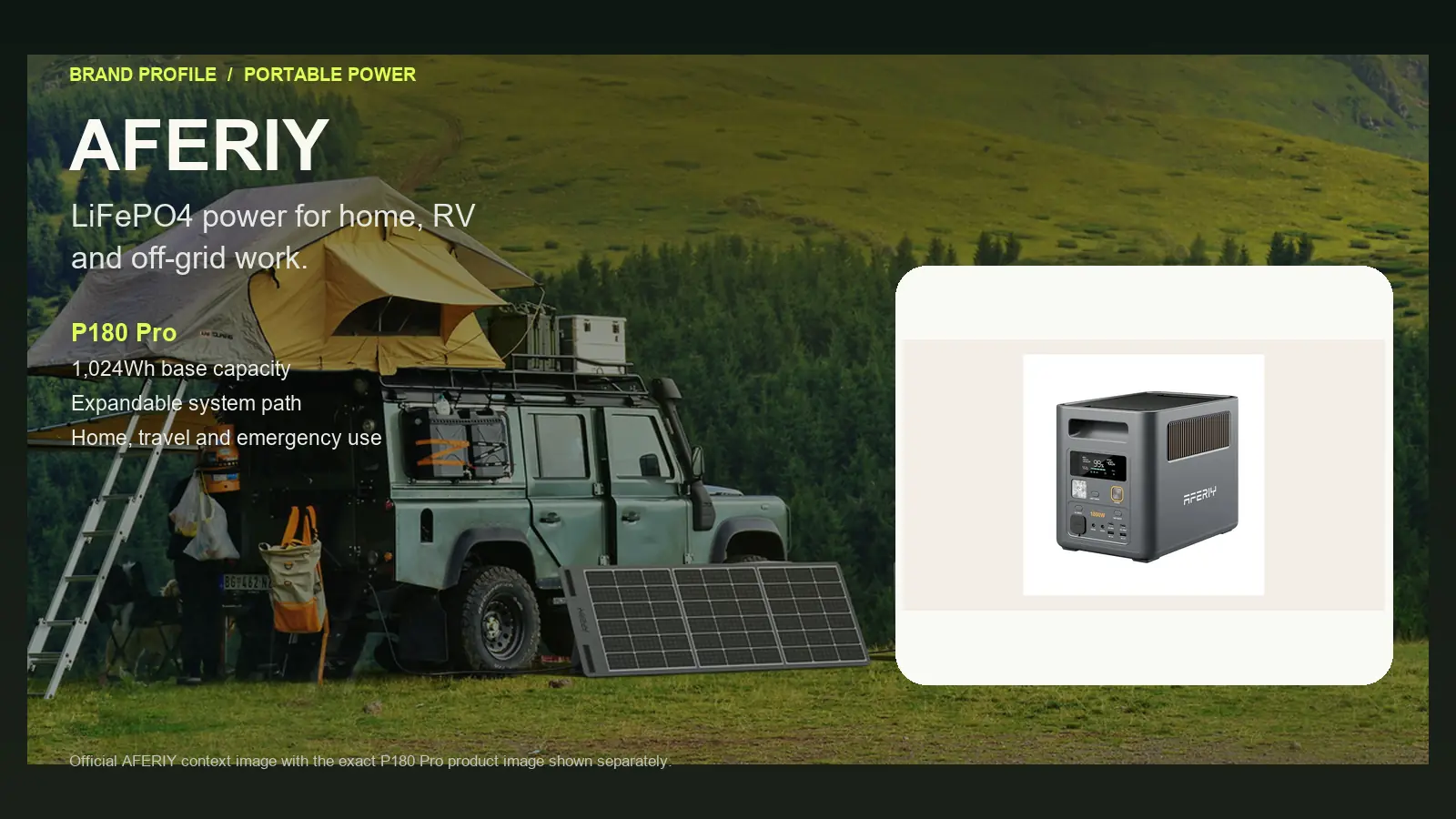
The P180 Pro is the clearest entry into the larger AFERIY ecosystem. Its published starting point is 1,024Wh with 1,800W AC output, and AFERIY says compatible batteries can expand the system to 5,120Wh.
That expansion path changes the purchase calculation. A compact fixed battery is one decision. An expandable system is a platform decision involving battery generations, maximum capacity, cable compatibility, charging time and where the extra batteries will live.
Why AFERIY leans on LiFePO4
LiFePO4 is a common battery chemistry for portable power stations because it supports long cycle-life claims and is less energy-dense than some older lithium-ion formulations. The trade-off is usually weight and volume. Buyers should not interpret “LiFePO4” as a complete quality guarantee.
The battery-management system, inverter design, cooling, firmware, cell matching and manufacturing controls determine how the complete product behaves. AFERIY publishes intelligent battery-management and cycle-life claims, but those remain manufacturer statements until independently measured for the exact model.
When comparing AFERIY with another LiFePO4 station, move past chemistry and compare:
- continuous AC output;
- surge behavior;
- usable capacity after conversion losses;
- solar voltage and current limits;
- AC recharge speed;
- battery-expansion compatibility;
- carrying weight and warranty.
Home, RV and off-grid are different jobs
AFERIY's catalog spans several environments that are easy to blur together.
A camper needs low weight, accessible outlets, a compact footprint and enough capacity for phones, laptops, cameras, a fan and perhaps a small fridge. Solar input matters when the vehicle alternator or campsite power is limited.
An RV user may need more runtime, a larger inverter and a workable solar or alternator charging plan. A 1kWh station can serve selected devices but is not a complete RV electrical system.
Home backup adds another layer. A portable station can run plug-in essentials during an outage, but household circuits require a safe transfer method and qualified design. An expandable battery does not replace a transfer switch, grounding review or local electrical inspection.
Off-grid use requires the longest view. Daily energy use, winter production, panel storage and alternative charging matter more than the largest advertised battery number.
What the P180 Pro represents
The P180 Pro is the most useful illustration of AFERIY's strategy. It starts around the common 1kWh class but offers more capacity later. AFERIY also lists AC charging, solar input, car charging and combined AC-plus-solar charging.
Those features are promising for a buyer who wants one flexible platform rather than several unrelated batteries. They also create more decisions. The owner must confirm the supported expansion batteries, maximum system size, solar voltage window and whether the complete expanded system remains practical to move and recharge.
AFERIY is therefore more compelling when the expansion path will be used. A buyer who will never add a battery should compare the base P180 Pro directly against fixed-capacity competitors rather than paying for unused system flexibility.
Buying checks before choosing AFERIY
Start with a load inventory. Record continuous watts, startup surge and daily energy for the devices that must run. Then compare the exact AFERIY model's AC output, surge allowance and capacity.
Next, verify the battery family. Do not assume that an accessory from one P-series product works with another. Check the exact regional page, battery model, communication cable and maximum system configuration.
Confirm the solar window as an electrical specification. Panel wattage alone is not enough. Voltage, current, connectors and mixed-panel restrictions matter. A 500W maximum is a ceiling, not a guaranteed production figure.
Finally, check the US configuration, included cables, warranty provider, return route and current price. Product pages, bundles and regional storefronts can change independently.
Current AFERIY coupon
The current code POWERSTORAGEGUI is listed for 2% off eligible AFERIY power stations. The offer was checked on AFERIY's official US store on November 23, 2026.
Earlier cart checks reduced a $429 station to $420.42 and an $899 station to $881.02. Those examples show how the percentage behaved in those specific carts; they are not a promise that every product or total will receive the same result.
Use the AFERIY coupon page for the current code, scope and checked date. Confirm the discount in the official cart before paying.
Who AFERIY fits
Our take: AFERIY is most relevant to a buyer who wants LiFePO4 storage, a value-focused price and a possible expansion path without jumping into the most expensive brand ecosystems.
It is a sensible research path for camping, RV travel, small-home outage planning and mobile work where the exact load list fits the chosen model. It is less compelling for a buyer who needs the lightest possible 1kWh unit, a verified independent ranking or a professionally installed whole-home battery.
Continue with AFERIY
AFERIY current offer
Compare AFERIY power stations
Confirm the exact model, regional configuration, included accessories and current eligibility before ordering.
Some links to manufacturer stores are commercial. We may earn a commission at no extra cost to you. Read the disclosure.
Evidence note
This is desk research checked November 23, 2026. Product claims come from AFERIY's official US pages. Power Storage Guide did not perform a first-hand performance test, and the underlying source ledger is retained outside the public website.