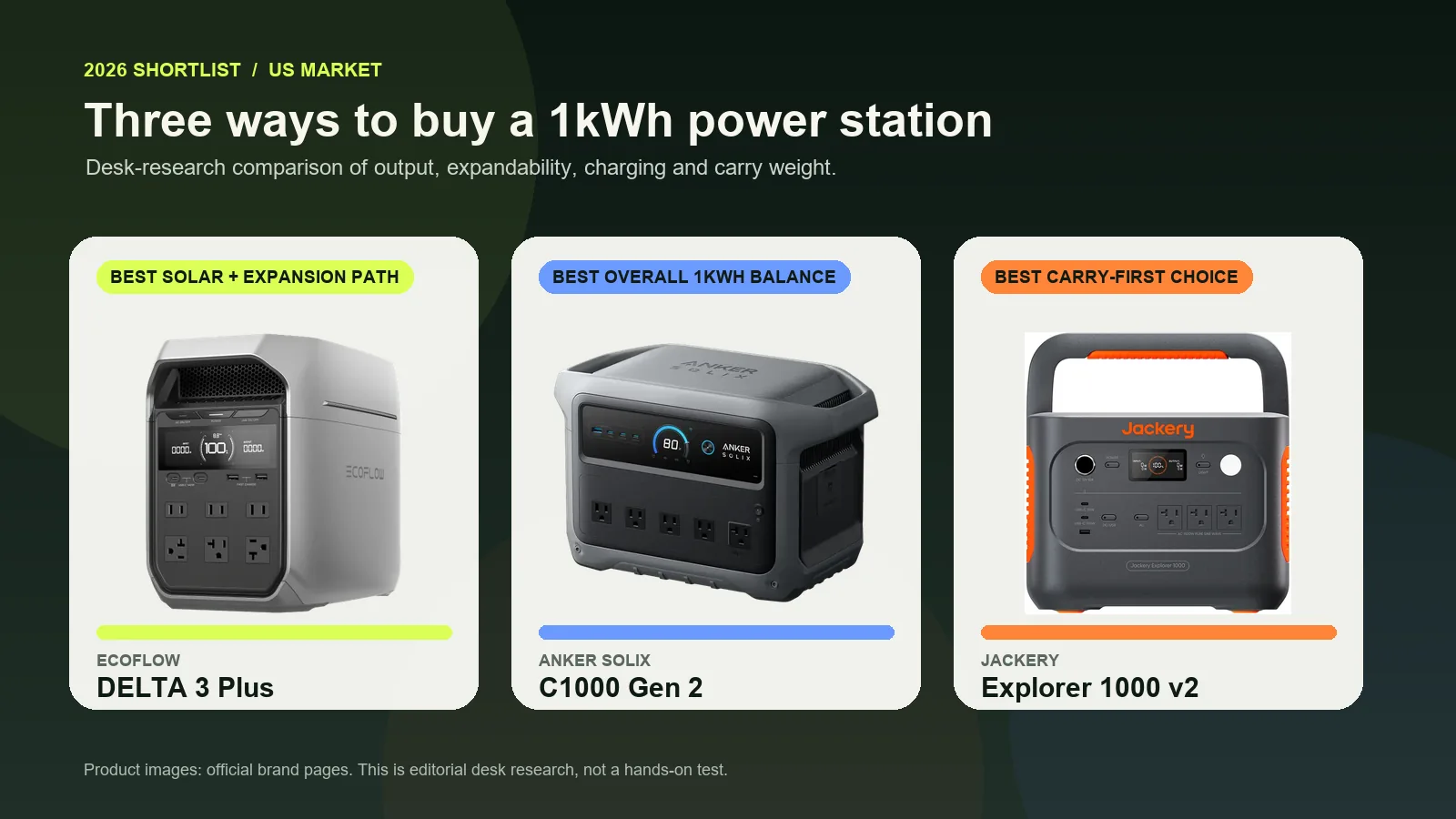
Quick verdict: Anker wins the everyday balance, EcoFlow wins the growth path
For most US buyers comparing a compact 1kWh power station in November 2026, the Anker SOLIX C1000 Gen 2 is the strongest all-round starting point. It combines a 1,024Wh LiFePO4 battery, a 2,000W AC inverter, five AC outlets and a 49-minute fast-charge claim in a 24.9lb package. It is easier to carry than the EcoFlow DELTA 3 Plus and has more AC headroom than the Jackery Explorer 1000 v2. [1][2][3]
That does not make it the universal winner.
- Choose the Anker SOLIX C1000 Gen 2 if output, port selection and quick AC turnaround matter more than adding batteries later.
- Choose the EcoFlow DELTA 3 Plus if you expect to add solar or expansion batteries. It is the only product in this three-way shortlist with a practical battery-expansion path.
- Choose the Jackery Explorer 1000 v2 if you carry the station frequently and want the lightest, simplest 1kWh unit in the group.
Evidence label: This is a desk-research guide. We compared official US specifications and named independent reviews; Power Storage Guide did not test these units in-house.
Why these are the three brands in this guide
“Hot” is a soft word, so this guide does not turn it into an audited sales claim. We used three public signals:
- Repeated recognition in recent independent buying guides.
- Presence in the current Amazon Outdoor Generators bestseller environment.
- A genuinely competitive product in the roughly 1kWh class, not just a large catalogue or a familiar logo.
The editorial signal is unusually clear right now. GearJunkie updated its portable-power guide on October 31, 2026 and named the Anker SOLIX C1000 Gen 2 its Best Overall pick. The Independent published its 2026 test roundup on October 30 and chose the EcoFlow DELTA 3 Plus as best overall. The same roundup also recognised Jackery and Anker in camper-van and home-backup categories. [6][7]
During our November 19 Amazon scan, the first page of the Outdoor Generators chart included several Jackery products near the top, EcoFlow DELTA units in the top five and the Anker SOLIX C1000 Gen 2 in the top ten. Marketplace charts move constantly and can include bundles, so we used them as a visibility signal rather than as a ranking of like-for-like base units. [8]
BLUETTI is the transparent runner-up. Its Elite 30 V2 also appeared in the same marketplace snapshot, and BLUETTI has strong independent coverage elsewhere. It is not in this three-model 1kWh shortlist because the requested decision set is the three most visible premium 1kWh families, not because the brand is uncompetitive. [8]
Scope and reader fit
This guide covers US-market, roughly 1kWh portable power stations that can run plug-in appliances without installation. The intended reader is comparing one of these jobs:
- camping and road trips;
- remote work or a camper van;
- short home outages;
- portable solar charging;
- a first power station before deciding whether a larger home-backup system is necessary.
The recommendations are not for whole-home wiring, medical life-support equipment, permanent balcony storage or an RV system that needs 240V output. Those are different electrical and installation decisions. Also confirm the exact regional model, outlet type, included accessories and current bundle before buying.
Quick picks at a glance
| Award | Exact model | Best for | Main trade-off | Price snapshot, November 19 |
|---|---|---|---|---|
| Best overall balance | Anker SOLIX C1000 Gen 2 | Most compact 1kWh buyers who need a strong inverter and easy carrying | No expansion-battery support | Amazon surfaces showed $469.99–$529.99 [3][8] |
| Best solar and expansion path | EcoFlow DELTA 3 Plus | Buyers planning extra panels or batteries | Heaviest of the three; high-load fan reports are mixed | Amazon listing showed about $649 [2][8] |
| Best carry-first choice | Jackery Explorer 1000 v2 | Frequent carrying, camping and simple device power | Lower AC output and a 400W solar ceiling; no expansion | $449 standalone on one Amazon surface; $559 basic on Jackery, listed sold out; $879 solar bundle [4][8] |
Prices are snapshots, not promises. The Amazon page can show different prices across Best Sellers, Most Wished For and individual listings; bundles can change the comparison entirely.
How we selected the winners
We weighted the purchase decision this way:
| Criterion | Weight | What it answers |
|---|---|---|
| Output and appliance fit | 25% | Can it start and run the loads a 1kWh buyer reasonably expects? |
| Capacity and expansion | 20% | Is stored energy appropriate, and can the system grow? |
| Recharge flexibility | 20% | Can the owner recover energy quickly by AC, solar or vehicle? |
| Portability and handling | 15% | Can one person move and store it for the intended use? |
| Ports and daily usability | 10% | Are the outlet types and control software useful without clutter? |
| Price and ownership clarity | 10% | Does the current offer make sense against the exact configuration? |
Specifications came from the official product pages and manuals. Performance observations came from publications that identified the product and described a test or extended use. The score is not a lab result. It is an editorial fit assessment, and the article is tied to the exact US models named above.
1. Best overall balance: Anker SOLIX C1000 Gen 2
Read the full Anker SOLIX C1000 Gen 2 desk review →
The C1000 Gen 2 is the easiest recommendation for a reader who wants one compact station to handle a laptop setup, lights, a small appliance and occasional higher loads. Anker gives it a 2,000W rated inverter with a 3,000W peak, against the DELTA 3 Plus's 1,800W rated output and the Explorer 1000 v2's 1,500W. [2][3][4]
That difference is not just a spec-sheet trophy. A stronger inverter gives more margin for a coffee maker, a small heater, a power tool or several devices at once. It does not make the station suitable for every appliance; startup surge, continuous load and ventilation still matter.
Published specifications that affect ownership
| Specification | Anker SOLIX C1000 Gen 2 | Why it matters |
|---|---|---|
| Capacity | 1,024Wh LiFePO4 | Standard 1kWh class; runtime still depends on conversion loss and load |
| Rated AC output | 2,000W; 3,000W peak | Highest AC headroom of the three compared |
| AC outlets | 5 | Useful for a small workspace without an extra strip |
| USB | 2 × 140W USB-C, 1 × 15W USB-C, 1 × 12W USB-A | Strong laptop and camera charging; the USB-A output is modest |
| Solar input | 600W maximum, 60V ceiling | Useful solar support, but below EcoFlow's 1,000W total |
| AC recharge claim | 49 minutes in UltraFast mode | Fast, but requires the app setting and suitable conditions |
| Weight | 24.9 lb | Light enough for short carries; still a two-hand lift |
| Expansion | Not supported on Gen 2 | Decide now whether growth matters |
Sources: Anker SOLIX US and MacRumors. [3][12]
Why it is the default pick
GearJunkie called the C1000 Gen 2 a benchmark in the 1kWh category after field use that included a dual-zone electric cooler and high-draw appliances. MacRumors ran a full Mac setup for almost 24 hours and reported that the unit also handled corded tools and household lights. Those are useful ownership scenarios, but they are not a guarantee that every load will behave the same way. [6][12]
The strongest practical advantage is the combination of output and carrying weight. The EcoFlow is larger and about 2.7lb heavier; the Jackery is lighter but gives up inverter headroom. If you move the station between a car, desk and kitchen, that balance is more important than a theoretical capacity difference of 46Wh.
Where the Anker falls short
The Gen 2 has no expansion-battery option. That is the most consequential limitation. A reader who expects to build a larger outage system later should not buy it and assume an add-on battery will appear. The EcoFlow is the cleaner growth path in this comparison.
Fast charging can also be loud in independent coverage, and the 600W solar ceiling requires carefully chosen panels to approach. Treat 49 minutes as a best-case mode, not a normal background behaviour. Confirm ventilation and acoustic expectations before putting it beside a bed or workspace. [3][12]
Buy it if: you want the strongest everyday blend of output, portability, outlets and fast AC charging, and you are comfortable with fixed capacity.
Skip it if: expansion, maximum solar-input headroom or the quietest possible fast charge are must-haves.
2. Best solar and expansion path: EcoFlow DELTA 3 Plus
Read the full EcoFlow DELTA 3 Plus desk review →
The DELTA 3 Plus sells a different promise: a compact starting battery that can become a larger energy system. EcoFlow lists two solar inputs, up to 1,000W total solar charging and a path to roughly 5kWh with compatible expansion batteries. Anker lists 600W solar for the C1000 Gen 2 and no expansion support; Jackery lists 400W solar and no expansion for the Explorer 1000 v2. [1][2][3][4]
That makes the EcoFlow the specialist pick rather than the default. If you already know you want a folding panel now and a larger battery later, paying for that architecture can make sense. If the station will live on a shelf and charge from a wall outlet, the extra ceiling may never pay for itself.
Published specifications that affect ownership
| Specification | EcoFlow DELTA 3 Plus | Why it matters |
|---|---|---|
| Capacity | 1,024Wh LiFePO4 | Same nominal class as the Anker |
| Rated AC output | 1,800W; 3,600W surge | Strong surge allowance, lower continuous rating than Anker |
| Solar input | Two 500W inputs, 1,000W total | The strongest solar path in this group |
| Ports | 6 AC, 2 × 140W USB-C, 2 × 36W USB-A, car and DC outputs | Excellent device coverage |
| Expansion | About 5kWh with compatible batteries and cable | A real growth path, but accessories add cost and footprint |
| Weight | About 27.6 lb | Heaviest of the three |
| AC recharge claim | About 56 minutes | Fast, with independent support for the general claim |
| UPS | Under 10ms | Useful for selected plug-in equipment, not an installation substitute |
| Warranty | Five years | Competitive on paper; confirm regional terms |
Sources: EcoFlow manual, EcoFlow US and TechRadar. [1][2][11]
What the independent evidence supports
TechRadar tested the DELTA 3 Plus in a home office, garden and vehicle and highlighted fast charging, outlet variety and UPS behaviour. Trusted Reviews found high AC efficiency around a 1,000W heater run, while noting heat and fan behaviour at higher loads. The result is a positive overall package with a thermal caveat rather than a universal “quiet” claim. [11][13]
The EcoFlow's 1,000W solar ceiling is only useful when the panel configuration fits the voltage window and there is enough physical space and sun. A 100W folding panel will not turn it into a 1,000W charger. Treat the input ceiling as a compatibility limit, not an expected output.
Where the EcoFlow falls short
It is the heaviest and largest unit in this comparison, and the continuous AC rating is lower than Anker's. The expansion path also creates ownership complexity: batteries, cables, charging time and storage footprint become part of the system. Check that the exact extra battery and cable are compatible with the US model you are buying.
Buy it if: you want one battery now, with a credible route to more solar and more storage later.
Skip it if: you want the lightest carry, the highest continuous AC output or a fixed all-in-one purchase with no ecosystem decisions.
3. Best carry-first choice: Jackery Explorer 1000 v2
Read the full Jackery Explorer 1000 v2 desk review →
The Explorer 1000 v2 is the easiest of the three to understand: 1,070Wh, 1,500W rated output, three AC outlets, three USB ports and a 23.8lb body. It is not the most powerful and cannot grow, but it is the most convincing choice when the station will be lifted often or stored in a small vehicle compartment. [4][5]
Jackery lists an emergency mode that can charge from zero to full in about 50 minutes, but the normal AC adapter time is about 1.58 hours and the fast mode is not the default in every use case. The solar ceiling is 400W. That is enough for a modest panel, not for a solar-first system. [4][5]
Published specifications that affect ownership
| Specification | Jackery Explorer 1000 v2 | Why it matters |
|---|---|---|
| Capacity | 1,070Wh LiFePO4 | Slightly more nominal energy than the other two |
| Rated AC output | 1,500W; 3,000W surge | Best for light devices; lower ceiling for high-draw appliances |
| AC outlets | 3 × 120V | Simple layout, but limited for a crowded desk |
| USB | 100W USB-C, 30W USB-C, 18W USB-A | Good enough for laptops and phones |
| Solar input | 400W maximum | Clear limitation for off-grid or solar-first use |
| Weight | About 23.8 lb | Lightest of the three |
| Expansion | Not supported | Fixed-capacity purchase |
| Price snapshot | $449 standalone on one Amazon surface; $559 basic on Jackery, listed sold out; $879 bundle | Compare the exact contents; the bundle is not a like-for-like standalone price |
Sources: Jackery US product page, Jackery Support and Amazon Best Sellers. [4][5][8]
Why the Jackery still earns a place
The Solar Lab calculated about 87.5% efficiency in a near-maximum-load test and found the emergency charging mode useful, while also identifying the 400W solar ceiling as a real limit. TechRadar's hands-on coverage described the unit as quiet, portable and capable of keeping a set of computers, cameras and lights going for a day. [14][11]
That is a coherent purchase: lighter carry, simpler controls and enough output for laptops, cameras, lights, routers and many small appliances. It is not the right choice for a buyer who wants the largest inverter or a future battery expansion.
Where the Jackery falls short
The 1,500W inverter, 400W solar input and fixed capacity are the three limitations to accept before checkout. A buyer with a high-demand appliance should compare the appliance's startup watts with the published surge specification instead of relying on the device category.
Buy it if: you carry the station regularly and value simple operation more than expansion or the strongest inverter.
Skip it if: you want to add batteries, run a high-draw appliance with more margin or use more than 400W of solar input.
The differences that actually change the decision
Output versus stored energy
All three are roughly 1kWh stations, but output is not identical. The Anker's 2,000W rated inverter is the most flexible for higher-draw plug-in appliances. The EcoFlow provides a 3,600W surge allowance and more solar/expansion flexibility. The Jackery keeps the lowest continuous output in exchange for lower weight.
Do not choose from the battery capacity alone. A larger battery can still fail to start a motor or heater if the inverter's surge and continuous limits are too low. Check the exact appliance label, startup demand and ventilation requirements.
For the direct scenario comparison, read EcoFlow DELTA 3 Plus vs Anker SOLIX C1000 Gen 2. It compares the two strongest units in this shortlist on exact US configurations, output, solar and ownership cost.
Expansion is a purchase decision, not an accessory note
Only the EcoFlow model has an expansion route in this shortlist. That matters if you want to build from a camping battery into a small outage system without buying a second unrelated station. It also means more parts to verify and store. The Anker and Jackery units should be bought as fixed systems.
Solar input is a ceiling, not a recharge promise
The published maximums are 1,000W for EcoFlow, 600W for Anker and 400W for Jackery. Real charging depends on panel voltage, current, connectors, angle, shade, temperature and the station's controller. A compatible 200W panel can be useful; four incompatible panels can be useless. Match the panel array to the exact input window before buying.
Carrying and placement change the category
At about 23.8lb, the Jackery is the easiest to move. The Anker is around 24.9lb and the EcoFlow around 27.6lb. Those numbers are close enough that a fit adult can move any of them across a room, but the difference matters when the station goes into a vehicle, up stairs or into a tent. Put the unit where it can ventilate and stay dry; none of these is a weatherproof permanent installation.
The price gap is smaller than the ecosystem gap
On November 19, the Amazon surfaces we checked showed the Anker around $469.99–$529.99 and the EcoFlow around $649, while the Jackery standalone surface showed $449 and the official basic unit showed $559 before selling out. These are not stable quotes. The more important point is that a low base price can become a poor value if you later need a panel, cable, expansion battery or larger inverter.
Who should choose something else
Choose a larger 2kWh-class system if your essential load list includes a full-size refrigerator, a large heater, a high-demand power tool or several appliances running at once for hours. A 1kWh station is a portable buffer, not a whole-home battery.
Choose a professionally installed home battery if the requirement is to back up wired circuits, a well pump, HVAC equipment or medical systems. Extension cords and portable station outlets do not replace a transfer switch, electrical inspection or local code compliance.
Choose a different portable model if you need weatherproof outdoor installation, 240V output, a wheeled chassis or a battery system that grows beyond 5kWh. Those requirements sit outside this shortlist.
Scenario-based verdict
Choose the Anker SOLIX C1000 Gen 2 for the most balanced first 1kWh station: high output, five AC outlets, fast charging and manageable weight.
Choose the EcoFlow DELTA 3 Plus when the ability to add solar and batteries later is worth carrying a heavier unit and paying more.
Choose the Jackery Explorer 1000 v2 when you will move the station often and can live with 1,500W output, 400W solar and no expansion.
Skip all three if the real requirement is whole-home backup, a permanently installed solar battery or a system that must power high-surge equipment continuously.
Read the underlying comparisons
- EcoFlow DELTA 3 Plus vs Anker SOLIX C1000 Gen 2
- EcoFlow DELTA 3 Plus desk review
- Anker SOLIX C1000 Gen 2 desk review
- Jackery Explorer 1000 v2 desk review
Frequently asked questions
Is a 1kWh power station enough for a refrigerator?
It can run some refrigerators for a limited period, but you must compare the refrigerator's running watts, startup surge, daily energy use and the station's continuous output. A 1kWh battery is not a guarantee of a fixed runtime; compressor cycling, temperature and conversion losses change the result. Check the appliance label and the exact station manual.
Which of these three is best for solar?
The EcoFlow DELTA 3 Plus has the highest published solar-input ceiling in this group at 1,000W total and the only expansion path. Anker's 600W ceiling is useful for a compact setup. Jackery's 400W ceiling is better suited to a modest panel and portable use.
Which one is easiest to carry?
The Jackery Explorer 1000 v2 is the lightest of the three at about 23.8lb. The Anker is about 24.9lb and the EcoFlow about 27.6lb. The shape of the handle, the distance carried and the need for two-hand lifting matter as much as the weight difference.
Can I use a power station to back up household wiring?
Do not connect one to household wiring without an approved transfer method and a qualified electrical review. Backfeeding a circuit can endanger utility workers and damage equipment. Use the station's own outlets for appropriate standalone loads.
Why is the price different between Amazon and the brand site?
Retailers, bundles, membership pricing, coupons, regional stock and timing can all change the offer. A lower price may exclude a solar panel, cable, expansion battery or other accessory. Compare the exact contents and seller, not only the headline price.
Is this a hands-on ranking?
No. This is a desk-research buying guide. It uses official specifications and named independent reviews, and it labels the limits of that evidence. Power Storage Guide did not receive these units for testing.
Update note
Specifications, prices and availability were checked on November 19, 2026 for the US market. Recheck the exact model page and bundle before purchase. A future firmware or product revision can change recharge behavior, app features or the included accessories.
Next step
Use the explainer in a buying decision
Evidence note
This is a desk-research buying guide checked November 19, 2026. Specifications come from official US product pages and manuals. Independent performance statements are attributed to named publications. Prices are volatile marketplace snapshots, not guaranteed totals.
Source list
- [1]EcoFlow DELTA 3 Plus user manualEcoFlow · accessed 2026-11-19
- [2]EcoFlow DELTA 3 Plus portable power stationEcoFlow US · accessed 2026-11-19
- [3]Anker SOLIX C1000 Gen 2 product pageAnker SOLIX US · accessed 2026-11-19
- [4]Jackery Explorer 1000 v2 product pageJackery US · accessed 2026-11-19
- [5]Explorer 1000 v2 basic informationJackery Support · accessed 2026-11-19
- [6]The 11 best portable power stationsGearJunkie · accessed 2026-11-19 · Updated October 31, 2026; names Anker SOLIX C1000 Gen 2 as Best Overall.
- [7]Best portable power stations for 2026The Independent · accessed 2026-11-19 · Published October 30, 2026; names EcoFlow DELTA 3 Plus best overall.
- [8]Amazon Best Sellers: Outdoor GeneratorsAmazon · accessed 2026-11-19 · Dynamic marketplace snapshot. Rankings and prices change throughout the day.
- [9]The best power stations of 2026OutdoorGearLab · accessed 2026-11-19 · Updated July 24, 2026; identifies Anker C1000 Gen 2 as the value pick for most users.
- [10]The best portable power stationsNBC Select · accessed 2026-11-19 · Published September 17, 2026.
- [11]Best portable power stationsTechRadar · accessed 2026-11-19
- [12]Anker SOLIX C1000 Gen 2 reviewMacRumors · accessed 2026-11-19
- [13]EcoFlow DELTA 3 Plus reviewTrusted Reviews · accessed 2026-11-19
- [14]Jackery Explorer 1000 v2 reviewThe Solar Lab · accessed 2026-11-19