Quick verdict: pick by the risk you expect later
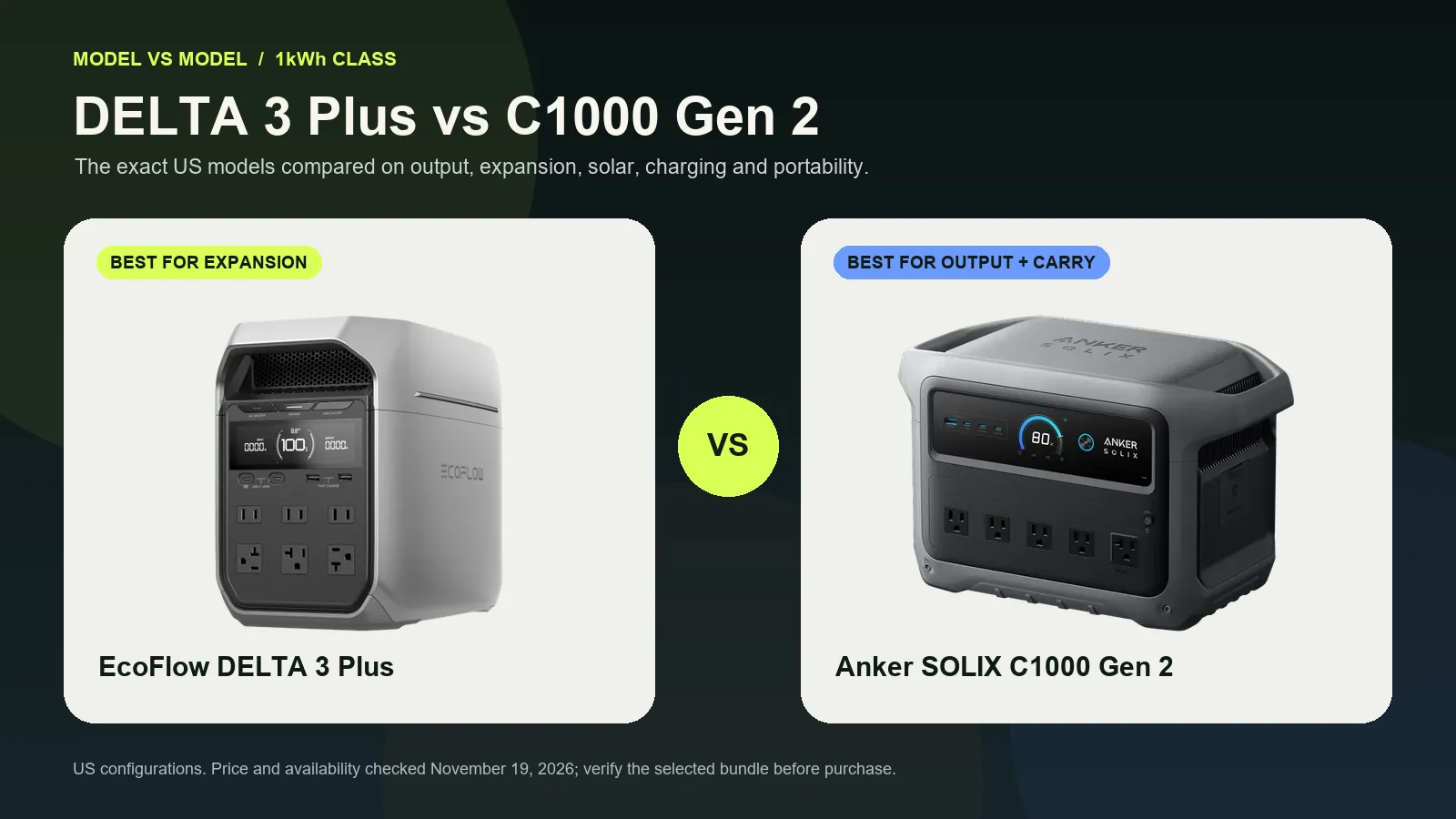
The Anker SOLIX C1000 Gen 2 is the better default for most US readers who want a compact 1kWh station with strong AC output, five outlets and the easiest carry of this pair. It is rated for 2,000W continuous and 3,000W peak, weighs 24.9lb and publishes a 49-minute full-charge claim when UltraFast mode is enabled. [1]
The EcoFlow DELTA 3 Plus is the better specialist buy when the purchase needs to grow. It has a lower 1,800W continuous AC rating, but adds two solar inputs totalling up to 1,000W and a path to roughly 5kWh with compatible expansion batteries. It also provides more outlets and a longer charging ecosystem to plan around. [2][3]
That is the central trade-off:
- Choose the Anker if portability, raw continuous output and a ready-to-use fixed battery matter more.
- Choose the EcoFlow if expansion and higher solar input are part of a real future plan.
- Do not call either one “best” without naming the load, the carrying distance and whether the battery must grow.
Evidence label: Desk comparison, not a first-hand test. The article names exact US-market models and separates official claims from independently reported observations.
Comparison scope: exact models, region and date
This comparison covers:
- EcoFlow DELTA 3 Plus, US configuration, model EF-DL-H10-4. [2]
- Anker SOLIX C1000 Gen 2, US configuration, model A1763. [1]
The checked date is November 19, 2026. Prices and stock are volatile and may differ across the brand store, Amazon listings and bundles. The comparison excludes the original C1000, larger Anker SOLIX C2000/F-series systems, EcoFlow River models and solar-generator bundles unless a bundle detail is necessary to explain price.
The Jackery Explorer 1000 v2 appears only as a portability reference. It is not one of the two models being scored here. Its separate review and the wider 1kWh guide are linked at the end.
At-a-glance comparison
| Decision factor | EcoFlow DELTA 3 Plus | Anker SOLIX C1000 Gen 2 | Why the difference matters |
|---|---|---|---|
| Capacity | 1,024Wh LiFePO4 [2] | 1,024Wh LiFePO4 [1] | Essentially identical nominal capacity |
| Rated AC output | 1,800W continuous; 3,600W surge [2] | 2,000W continuous; 3,000W peak [1] | Anker has more continuous headroom; EcoFlow advertises a higher short surge |
| AC outlets | 6 [2] | 5 [1] | EcoFlow is easier for a crowded small workspace |
| USB | 2 × 140W USB-C, 2 × 36W USB-A [2] | 2 × 140W USB-C, 1 × 15W USB-C, 1 × 12W USB-A [7] | Anker adds an extra USB-C; EcoFlow's USB-A ports are more useful |
| Maximum solar | 1,000W total across two inputs [2] | 600W, 60V maximum [1] | EcoFlow is the stronger solar-first choice |
| Battery expansion | About 5kWh with compatible batteries [2] | Not supported on Gen 2 [1] | The biggest structural difference |
| Weight | About 27.6lb [2] | 24.9lb [1] | Anker is easier to carry and move |
| AC recharge claim | About 56 minutes [2][4] | 49 minutes in UltraFast mode [1][9] | Both are fast; Anker is slightly quicker on paper |
| UPS | Under 10ms [2] | 10ms [1] | Similar published claim; neither replaces safe circuit transfer equipment |
| Cycle claim | At least 80% after 4,000 cycles [2] | At least 80% after 4,000 cycles [1] | Similar published longevity target |
| Price snapshot | About $649 on Amazon [12] | $469.99–$529.99 across Amazon surfaces [12] | Recheck exact seller, bundle and official price |
The price row is intentionally a range. On the same November 19 check, Amazon's Best Sellers and Most Wished For surfaces exposed different Anker prices. That is why a price claim without a timestamp and configuration is not useful.
Positioning: one expands, the other optimises the box
The EcoFlow and Anker names both span much larger products. This comparison stays at the exact 1kWh models because brand-level claims would hide the purchase risk. EcoFlow is selling flexibility: more solar, more ports and a path to add batteries. Anker is selling density and speed: a stronger inverter and lower carrying weight in a compact fixed system. [1][2]
The product-line context matters in one way. If you later decide that 1kWh is not enough, EcoFlow gives you a defined add-on route with the DELTA 3 Plus. Anker requires a larger separate product when the Gen 2 capacity no longer fits. That is not a defect in the Anker; it is a purchase-scope decision.
1. AC output: Anker has the clearer everyday advantage
Anker publishes 2,000W continuous and 3,000W peak. EcoFlow publishes 1,800W continuous and 3,600W surge, with X-Boost behaviour for some devices. These are not interchangeable numbers. Continuous output describes the load the inverter is designed to support for a period; a surge figure describes a brief startup allowance under specified conditions. [1][2]
For a buyer running a coffee maker, a small heater, a torch or a blender, the Anker's higher continuous number provides more margin before the station reaches its published ceiling. For a motor or compressor with a brief startup spike, the EcoFlow's higher surge number can look attractive, but the appliance's actual startup profile and the station's protection behaviour still need to be checked.
Neither model should be treated as a continuous 3kW generator. Do not plan long high-load runs without ventilation, and do not assume every appliance labelled below the inverter limit will start.
2. Capacity and expansion: EcoFlow wins the long-term decision
Both stations store 1,024Wh. The difference is what happens after you learn your real consumption.
EcoFlow publishes a supported path to roughly 5kWh using compatible expansion batteries and the specified cable. This is useful for a buyer who wants to start with a portable unit and later extend outage coverage. It also introduces extra costs, storage requirements and compatibility checks. The battery is not included in the base price, and the station becomes less portable as the system grows. [2]
Anker explicitly does not support battery expansion on the C1000 Gen 2. That simplifies ownership: one box, one capacity, no accessories to match later. It also means the buyer must be honest about the intended job now. [1]
If you expect to run essential loads for multiple days or add storage after the first season, the EcoFlow's architecture is worth the extra complexity. If the station is primarily for weekends, remote work and short outages, the Anker's fixed-capacity design is easier to live with.
3. Solar and recharge: EcoFlow has more ceiling, Anker has more speed
The DELTA 3 Plus supports two solar inputs with a combined 1,000W maximum. Anker's C1000 Gen 2 supports up to 600W solar with a 60V ceiling. EcoFlow wins the headline solar number, but the buyer still needs panels that match the voltage window, connectors and current limits. A high input ceiling with a low-voltage folding panel will not produce the advertised maximum. [1][2]
AC charging is closer. Anker's 49-minute claim uses the 1,600W UltraFast mode, which must be enabled in the app and depends on battery temperature. The Technology Man measured a 47-minute full recharge and found the process audible; MacRumors also reported loud operation during fast charging or high-draw use. [1][7][9]
EcoFlow's 56-minute claim is backed by independent fast-charge observations in the reviews linked below. It has a larger solar ceiling, but it is also the heavier station. The right choice depends on whether the recharge plan is mostly wall power, a vehicle or a panel array.
4. Portability and handling: Anker is easier to move
At 24.9lb, the Anker is about 2.7lb lighter than the EcoFlow's 27.6lb. That is not a dramatic difference on a spec table, but it matters in repeated loading and unloading, stairs, small vehicles and campsite setup. The Anker's compact body also makes it easier to place on a desk or shelf. [1][2]
The EcoFlow's extra outlets and expansion support come with more footprint. Choose it only after checking where it will live, whether the cable path is safe and who will move it. Neither station is weatherproof for permanent outdoor installation, and both should be kept dry, ventilated and away from standing water.
5. Ports and software: both are capable, with different layouts
EcoFlow provides six AC outlets, two 140W USB-C ports, two 36W USB-A ports, a car socket and two DC5521 outputs. That is excellent coverage for a small work or emergency setup. Anker provides five AC outlets, two 140W USB-C ports, one 15W USB-C port, one 12W USB-A port and a car output. [1][2][7]
Anker's six-port USB layout can be useful when several smaller devices need to charge together, but the 12W USB-A output is not a fast-charge port. EcoFlow's 36W USB-A ports are more useful for older high-draw accessories. Both have app support; verify current firmware, account requirements and local device compatibility before relying on remote monitoring.
6. Cost and ownership value
The current price gap favours Anker on a like-for-like base-unit basis: our November 19 Amazon snapshot found roughly $469.99–$529.99 for the C1000 Gen 2 and about $649 for the DELTA 3 Plus. The exact totals change with seller, membership, coupons, tax and bundle contents. [12]
The Anker is the better value if you are buying a fixed 1kWh system and do not need expansion. The EcoFlow can still be the better value if you would otherwise buy a second station or a larger battery later. Price the entire setup: station, panels, cables, expansion battery and the space required to store it.
There is also a service and repair question. Confirm warranty territory, authorised sellers and the support path in your country. A lower street price from an unclear seller can be worse than a higher official price if service is difficult.
Scenario recommendations
Choose the Anker SOLIX C1000 Gen 2 if:
- you want the strongest continuous AC output in a compact 1kWh package;
- the station will be carried between a car, desk and room;
- you value five AC outlets and fast wall charging;
- you are comfortable buying a fixed-capacity unit;
- your solar plan is modest or secondary.
Choose the EcoFlow DELTA 3 Plus if:
- you expect to add an expansion battery later;
- you want the highest solar-input ceiling in this pair;
- you need more USB-A and DC output options;
- you can accommodate about 27.6lb and a larger footprint;
- you plan to keep the station for a growing emergency setup rather than only occasional travel.
Choose neither if:
- you need whole-home wiring, a transfer switch or 240V output;
- you need a weatherproof permanent installation;
- you expect the station to run a high-draw appliance continuously for hours;
- your essential loads require a larger battery or a professionally installed system;
- you cannot verify the exact US model, price and included accessories.
Pros and cons
EcoFlow DELTA 3 Plus
Pros
- 1,000W total solar input across two ports. [2]
- Expandable to roughly 5kWh with compatible batteries. [2]
- Six AC outlets and a broad set of USB and DC ports. [2]
- Fast charging and useful UPS behaviour supported by independent coverage. [4][5]
- Five-year published warranty. [2]
Cons
- Heavier and larger than the Anker. [1][2]
- Lower continuous AC output despite a higher surge claim. [1][2]
- Expansion batteries and cables are separate purchases. [2]
- High-load fan and temperature reports are not consistent across reviewers. [4][6]
- The standalone offer can be out of stock while bundles remain. [2]
Anker SOLIX C1000 Gen 2
Pros
- 2,000W continuous / 3,000W peak output. [1]
- About 24.9lb and easier to carry than the EcoFlow. [1][2]
- Five AC outlets and two 140W USB-C ports. [1][7]
- 49-minute fast charging supported by multiple independent observations. [7][9]
- 10ms UPS and a 4,000-cycle-to-80% published rating. [1]
Cons
- No expansion-battery support on this generation. [1]
- Fast charging can be loud. [7][9]
- 600W solar ceiling is below the EcoFlow's 1,000W. [1][2]
- The small USB-A port is only 12W. [7]
- Current Amazon price varies between listing surfaces.
Final verdict
For most readers, the Anker SOLIX C1000 Gen 2 is the better 1kWh purchase in this exact comparison. It gives more continuous AC output, lower weight, a simpler fixed system and strong fast-charging evidence. It is the station to buy when the job is clear and done.
The EcoFlow DELTA 3 Plus wins the condition where the purchase is expected to grow. The solar ceiling, outlet variety and expansion path are meaningful, and independent reviews support the core charging experience. Buy it for the system you intend to build, not for the hope that one day you might add a battery.
Read the underlying model reviews
- EcoFlow DELTA 3 Plus desk review
- Anker SOLIX C1000 Gen 2 desk review
- Best 1kWh power stations: three-model buying guide
- Jackery Explorer 1000 v2: the carry-first alternative
FAQ
Which has more usable AC power?
On published continuous ratings, the Anker SOLIX C1000 Gen 2 leads at 2,000W versus the EcoFlow DELTA 3 Plus at 1,800W. EcoFlow advertises a higher short-term surge, but that does not erase the continuous-output advantage. Match the appliance label and startup needs to the exact model. [1][2]
Can I add a battery to either one?
EcoFlow publishes an expansion path to roughly 5kWh with compatible batteries and cable. Anker states that the C1000 Gen 2 does not support expansion. Verify the exact accessory compatibility on the US listing before purchase. [1][2]
Which is better for solar?
EcoFlow has the higher published maximum at 1,000W total versus Anker's 600W. The EcoFlow is the better starting point for a larger panel plan, provided the panels, voltage and connectors match. Anker's 600W ceiling can still be useful for a compact setup. [1][2]
Which is easier to carry?
Anker is lighter at 24.9lb versus about 27.6lb for EcoFlow. The difference is meaningful for stairs or repeated vehicle loading, though both should be lifted with two hands. [1][2]
Does the faster charging claim mean the station is always quiet?
No. Anker's fastest mode is a purposeful, high-power mode. Independent reviewers reported audible operation during fast charging and heavy loads. Use standard charging when noise matters, if that mode suits your schedule. [7][9]
Are these prices guaranteed?
No. The $469.99–$529.99 Anker range and $649 EcoFlow snapshot were observed on November 19, 2026 and can change by seller, membership, coupon and bundle. Confirm the exact US model and contents at checkout. [12]
Update note
This comparison was last checked on November 19, 2026. Specifications, price surfaces and bundle contents can change. If a new firmware release alters charging or thermal behavior, treat the old observation as historical rather than permanent.
Next step
Use the explainer in a buying decision
Evidence note
This is a desk comparison of the US-market EcoFlow DELTA 3 Plus and Anker SOLIX C1000 Gen 2, checked November 19, 2026. Published specifications come from the brands; performance observations are attributed to named independent reviews.
Source list
- [1]EcoFlow DELTA 3 Plus user manualEcoFlow · accessed 2026-11-19
- [2]EcoFlow DELTA 3 Plus portable power stationEcoFlow US · accessed 2026-11-19
- [3]Anker SOLIX C1000 Gen 2 product pageAnker SOLIX US · accessed 2026-11-19
- [4]EcoFlow Delta 3 Plus portable power station reviewTechRadar · accessed 2026-11-19
- [5]EcoFlow Delta 3 Plus reviewTrusted Reviews · accessed 2026-11-19
- [6]EcoFlow Delta 3 Plus reviewHow-To Geek · accessed 2026-11-19
- [7]Review: Anker SOLIX C1000 Gen 2MacRumors · accessed 2026-11-19
- [8]Anker SOLIX C1000 Gen 2 reviewAndroid Authority · accessed 2026-11-19
- [9]Record-breaking charge speed? Anker SOLIX C1000 Gen 2 reviewThe Technology Man · accessed 2026-11-19
- [10]The 11 best portable power stationsGearJunkie · accessed 2026-11-19 · Updated October 31, 2026.
- [11]Best portable power stations for 2026The Independent · accessed 2026-11-19 · Published October 30, 2026.
- [12]Amazon Best Sellers: Outdoor GeneratorsAmazon · accessed 2026-11-19 · Dynamic price and ranking snapshot only.