Quick verdict: buy it for the carry, not the ceiling
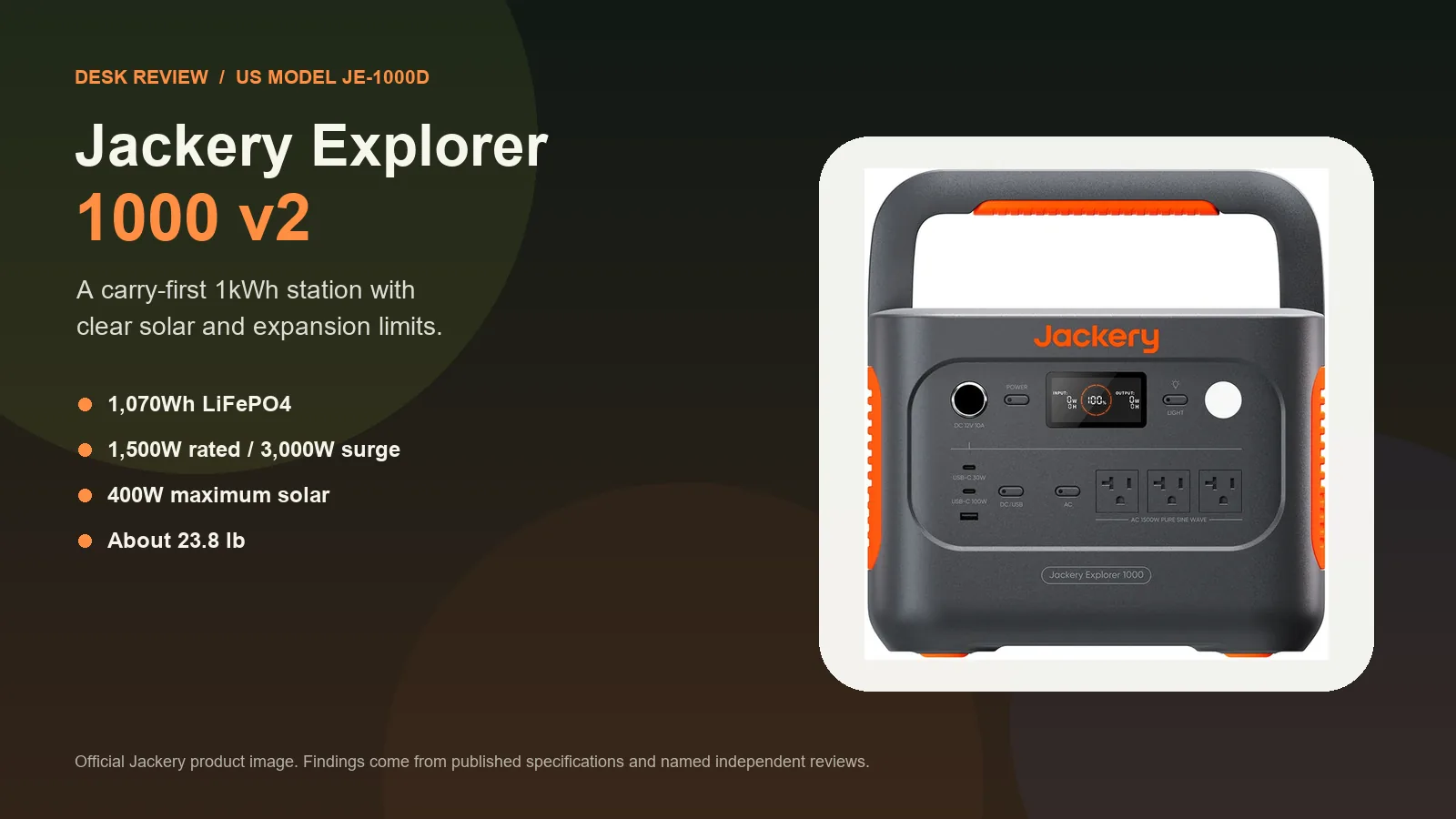
The Jackery Explorer 1000 v2 is a strong 1kWh power station for people who will actually move it. Its roughly 23.8lb weight, folding handle and simple outlet layout make it easier to carry than the EcoFlow DELTA 3 Plus and Anker SOLIX C1000 Gen 2, while its 1,070Wh LiFePO4 battery and 1,500W / 3,000W surge inverter cover camping, remote work and many short outage loads. [1][2]
It is not the best choice for a buyer who wants more AC output, more solar input or a system that grows. Jackery limits the model to 400W of solar input and does not support battery expansion. [1][2]
Desk-review score: 8.2/10. The score reflects documented ownership fit, not a laboratory test performed by Power Storage Guide.
Buy it if: portability and simple operation matter more than expansion and maximum output.
Choose another model if: you want an EcoFlow-style expansion route, Anker's 2,000W inverter or a 2kWh battery.
Wait if: the current seller and included configuration are unclear. The US site has shown the basic unit sold out while a $879 solar bundle remained a different offer.
Exact product identity and evidence standard
This review covers the US-market Explorer 1000 v2, model JE-1000D, with 1,070Wh capacity and three 120V AC outlets. It is not the original Explorer 1000, the Explorer 2000 v2 or a solar-generator bundle unless explicitly stated. [1][2]
We did not receive a review sample and did not perform first-hand measurements. Jackery's product page and support documentation establish published specifications. TechRadar and The Solar Lab are used for independent performance observations. Their tests are not interchangeable; each reviewer used a different load, environment and calculation method. [1][3][4]
The evidence label is intentionally narrow: desk review, US configuration, checked November 19, 2026.
Jackery Explorer 1000 v2 specifications
| Specification | Published detail | Source |
|---|---|---|
| Model / market | JE-1000D; US listing | [1][2] |
| Capacity | 1,070Wh, 35.2V / 30.4Ah | [1] |
| Battery chemistry | LiFePO4 | [1][2] |
| Rated AC output | 1,500W; 3,000W surge peak | [1] |
| AC outlets | 3 × 120V | [1] |
| USB outputs | 100W USB-C, 30W USB-C, 18W USB-A | [1] |
| Other output | 12V car socket | [1] |
| Solar input | Two DC ports, 400W total maximum | [1][2] |
| Standard AC charging | About 1.58 hours | [1] |
| Emergency fast charge | Up to 50 minutes in the stated mode | [1][2] |
| Weight | About 23.8lb / 10.8kg | [1] |
| Cycle claim | 4,000 cycles to at least 70% capacity | [1] |
| UPS | 20ms or less | [1] |
| Expansion | Not supported | [1][2] |
| Warranty | 3 years plus 2-year extension under qualifying purchase terms | [1][2] |
The solar ports are not a license to connect any panel collection. Jackery's support material specifies voltage, current and panel-matching conditions, including connector adaptation. Confirm the exact panel, cable and series/parallel arrangement before purchase. [2]
How we evaluated the purchase
This review weights the factors that change ownership:
| Criterion | Weight | What the evidence can support |
|---|---|---|
| Capacity and AC fit | 25% | Published capacity and inverter limits, plus independent load observations |
| Portability | 20% | Weight, dimensions and handle design |
| Charging flexibility | 20% | AC, solar and car input claims |
| Output and port usefulness | 15% | AC and USB counts, power limits and layout |
| Long-term ownership | 20% | Chemistry, cycle claim, warranty, expansion and service conditions |
The weighting is editorial judgment. The individual specifications and performance observations remain separately sourced.
Real-world performance: what independent reviewers found
TechRadar's coverage used the Explorer 1000 v2 with computers, a camera, a drone and lighting. It reported that the station kept the group running through a day and that a MacBook Pro stayed charged with roughly a continuous 100W draw for six hours. It also described the simulated outage switchover as seamless when used with a 3D printer. That is a useful real-world scenario, not a universal guarantee for every sensitive load. [3]
The Solar Lab's review measured about 87.5% efficiency under a near-maximum load and found the emergency charging mode effective, while identifying the 400W solar ceiling as a limitation. Those results support the station's basic power conversion and portability, but they do not establish identical efficiency for every load or battery age. [4]
The expected runtime is not a simple division of 1,070Wh by appliance watts. Inverter conversion, standby consumption, battery temperature and the appliance's cycling pattern all reduce the energy delivered to the outlet.
Output and outlets: enough for the right loads, not every load
The 1,500W continuous rating is the important boundary. A laptop, router, monitor, camera battery, fan, light and many small kitchen appliances fit comfortably within the station's intended range. A larger heater, multiple high-draw appliances or a motor with a demanding startup can exceed the practical envelope even when the surge label looks sufficient. [1]
Three AC outlets are enough for a simple workspace or a small collection of appliances. They are less convenient than the five and six outlets on the Anker and EcoFlow models. Two USB-C ports and one USB-A port cover the common phone, tablet and laptop combination; the 30W USB-C port is slower than the 100W port. [1][9][10]
The station does not turn a 1,500W appliance into a continuous 3,000W appliance. The surge rating is a short allowance, not a second operating mode.
Portability and ownership
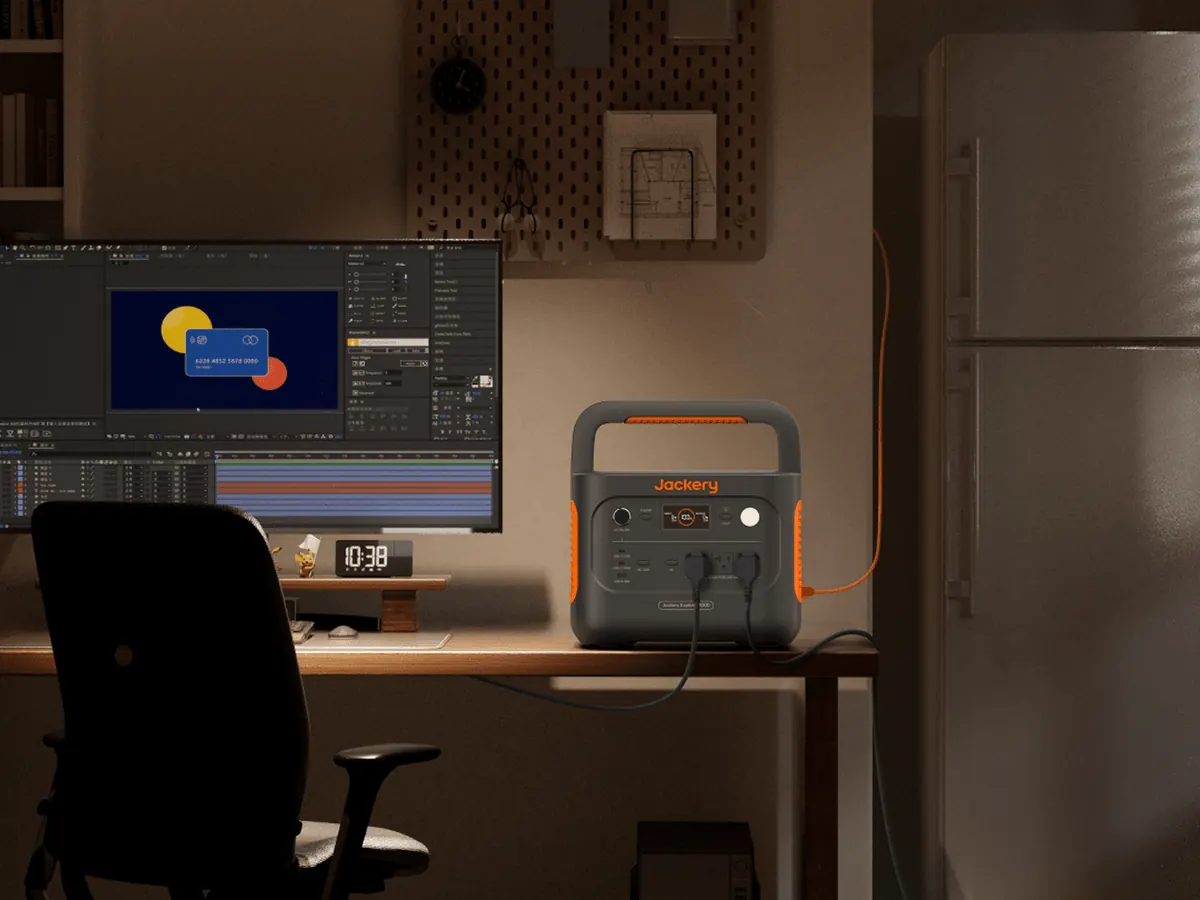
The Explorer 1000 v2 is the lightest of the three brands in our current 1kWh comparison at about 23.8lb. It is still a two-hand lift for many people, especially when moving it up stairs or into a vehicle. The folding handle makes short carries easier; it does not make the product pocketable or suitable for a long hiking carry. [1]
Jackery's 20ms UPS claim is useful for selected plug-in equipment, but it is not a substitute for an approved transfer switch or a professionally designed home-backup circuit. Confirm the exact device's tolerance and test the arrangement before relying on it. Keep the unit dry, ventilated and away from direct sun or standing water. [1]
The app adds monitoring and control, but do not assume every feature remains available without an account, firmware update or local network. Test the app and Bluetooth connection during the return window if remote control is essential.
Charging and solar limits
The standard wall charge is roughly 1.58 hours. The emergency mode can shorten the fastest published result to about 50 minutes, but the mode, temperature and starting state matter. Treat the faster number as a convenience for a planned trip, not as the normal background charge for every day. [1][2]
Solar is the clearer limitation. The 400W maximum is below the DELTA 3 Plus's 1,000W total and the C1000 Gen 2's 600W ceiling. It is enough for a compact folding panel and a low-demand camping routine. It is not the best foundation for an off-grid system expected to recover a full battery quickly from solar. [1][9][10]
Panel compatibility is an electrical question. Check open-circuit voltage, operating voltage, current, connector type and the maximum input. Jackery also warns against casually mixing panel models. A panel that says 200W will not necessarily deliver 200W into the station in real conditions. [2]
Price and value
On November 19, 2026, the Jackery US page showed the basic Explorer 1000 v2 at $559, listed sold out, and a 200W solar bundle at $879, also listed sold out. Amazon's current chart and wish-list surfaces exposed a $449 standalone offer and a separate $879 solar bundle. The official product page can move between standalone and bundle states. [1][8]
The buyer should compare:
- the base station and AC cable only;
- the same station with a 200W panel;
- the seller and warranty terms;
- delivery date and stock status;
- whether the panel, adapters and cable are included.
At a $449 standalone snapshot, the Jackery is a credible value pick for a carry-first buyer. At a bundle price, it competes with a different job: a small solar kit. Do not compare the bundle price with the Anker's or EcoFlow's base-unit price unless the accessories are equivalent.
Alternatives
Anker SOLIX C1000 Gen 2
The C1000 Gen 2 is the better alternative when continuous output and fast AC charging matter more than the last few pounds. It provides 2,000W rated output, five AC outlets and a roughly 24.9lb body, but it does not support expansion. Read the full C1000 Gen 2 review. [9]
EcoFlow DELTA 3 Plus
The DELTA 3 Plus is the alternative for a buyer who wants a path to roughly 5kWh and up to 1,000W of solar input. It is heavier and has a lower continuous AC rating, so it is a system decision rather than a pure portability upgrade. Read the full DELTA 3 Plus review. [10]
Jackery Explorer 2000 v2
If you need more stored energy and can accept a heavier fixed-capacity unit, the Explorer 2000 v2 is the next step in the Jackery catalog. It was not part of this 1kWh comparison, so do not use this review to infer its output, thermal behavior or current bundle contents.
Pros and cons
Pros
- About 23.8lb, the lightest of the three 1kWh models compared here. [1]
- 1,070Wh LiFePO4 capacity and a 1,500W / 3,000W surge inverter suit many portable loads. [1]
- Independent coverage supports useful real-world laptop, camera, lighting and outage scenarios. [3][4]
- Standard AC charging is under two hours, with a faster emergency mode available. [1]
- Three AC outlets, two USB-C ports and one USB-A port are sufficient for a simple setup. [1]
- The published 4,000-cycle and UPS ratings are competitive on paper. [1]
Cons
- Only 1,500W continuous AC output. [1]
- Solar input tops out at 400W. [1][2]
- No expansion-battery support. [1][2]
- Three AC outlets are modest for the capacity. [1]
- The fast emergency mode is not the same as the normal charging default. [1]
- Direct-store stock and bundle pricing can change quickly. [1][8]
Verdict
Buy the Jackery Explorer 1000 v2 if your priority is a relatively light 1kWh station that is easy to carry, simple to use and capable of running laptops, cameras, lights, routers and modest appliances. It is a coherent product for camping, road trips, remote work and short outages.
Choose the Anker SOLIX C1000 Gen 2 if you want more continuous AC output and are content with fixed capacity. Choose the EcoFlow DELTA 3 Plus if expansion and a larger solar-input ceiling are worth the extra weight and cost.
Do not buy any of them as a replacement for a wired home battery or for life-support equipment. Confirm the exact US configuration, return policy and seller before purchase.
Continue comparing
- Best 1kWh portable power stations for 2026
- EcoFlow DELTA 3 Plus vs Anker SOLIX C1000 Gen 2
- Anker SOLIX C1000 Gen 2 desk review
- EcoFlow DELTA 3 Plus desk review
FAQ
Is the Jackery Explorer 1000 v2 a 1,000Wh or 1,070Wh station?
The current US product page lists 1,070Wh. Older Explorer 1000 generations and bundle descriptions can use different numbers, so confirm the model code and the technical-spec table rather than relying on the family name. [1]
Can the Explorer 1000 v2 be expanded with another battery?
No. Jackery's current product documentation says this model does not support capacity expansion. A second station can be used as a separate power source, but that is not the same as a supported battery-expansion system. [1][2]
What can 1,500W run?
It can run many small appliances and electronics within the continuous rating. It may also start some loads within the 3,000W surge allowance, but startup behavior varies by motor or compressor. Check the appliance label and the station manual, and avoid continuous operation near the limit without ventilation.
How fast does it charge from the wall?
The standard AC adapter time is about 1.58 hours. The emergency mode can reach a faster published time of about 50 minutes under its stated conditions. The default mode, temperature and battery state affect the result. [1]
Does it work with solar panels from other brands?
Sometimes, but compatibility depends on voltage, current, connectors and the total input limit. Use the station's exact input window and panel documentation. Do not assume that a physical connector match proves electrical compatibility. [2]
Is this a hands-on test?
No. It is a desk review based on published specifications and named independent reviews. The official lifestyle image is illustrative context and is not evidence that Power Storage Guide tested the unit.
Update note
This review was checked on November 19, 2026 for the US market. Recheck current stock, price, warranty registration and bundle contents before buying. A product revision or firmware update may change the behaviour described here.
Next step
Use the explainer in a buying decision
Evidence note
This is a desk review of the US-market Jackery Explorer 1000 v2, model JE-1000D, checked November 19, 2026. Specifications come from Jackery. Performance findings are attributed to named independent publications; no first-hand testing is claimed.
Source list
- [1]Jackery Explorer 1000 v2 product pageJackery US · accessed 2026-11-19
- [2]Explorer 1000 v2 basic informationJackery Support · accessed 2026-11-19
- [3]Best portable power stationsTechRadar · accessed 2026-11-19
- [4]Jackery Explorer 1000 v2 reviewThe Solar Lab · accessed 2026-11-19
- [5]Best portable power stations for 2026The Independent · accessed 2026-11-19 · Published October 30, 2026.
- [6]The 11 best portable power stationsGearJunkie · accessed 2026-11-19 · Updated October 31, 2026.
- [7]The best portable power stationsNBC Select · accessed 2026-11-19 · Published September 17, 2026.
- [8]Amazon Best Sellers: Outdoor GeneratorsAmazon · accessed 2026-11-19 · Dynamic marketplace snapshot; rankings and prices change.
- [9]Anker SOLIX C1000 Gen 2 product pageAnker SOLIX US · accessed 2026-11-19
- [10]EcoFlow DELTA 3 Plus user manualEcoFlow · accessed 2026-11-19